
Vacation Photography
Flynn Marr 21 February 2026

On board the ship, away from work and the calendar in the kitchen, it is easy to forget what day of the week it is. On the Eurodam however this is not a problem. In every elevator they change the carpet every day to tell you what day it is.
Leaving Warneműnde after a day ashore the Eurodam set out for Helsinki on the far side of the Baltic and the next day was spent at sea. I enjoy the days we simply float on the ocean, out of sight of land, just water and sky, with no obligations to go ashore to see some city or other.
Susan goes to exercise in the morning and I go down to the Coffee Bar for a latte and to work on my pictures with my laptop. We meet for lunch and then Susan usually ends up by the pool while I wander with my camera looking for pictures or maybe have a nap. It is wonderful. No pressure to do anything. I love it.
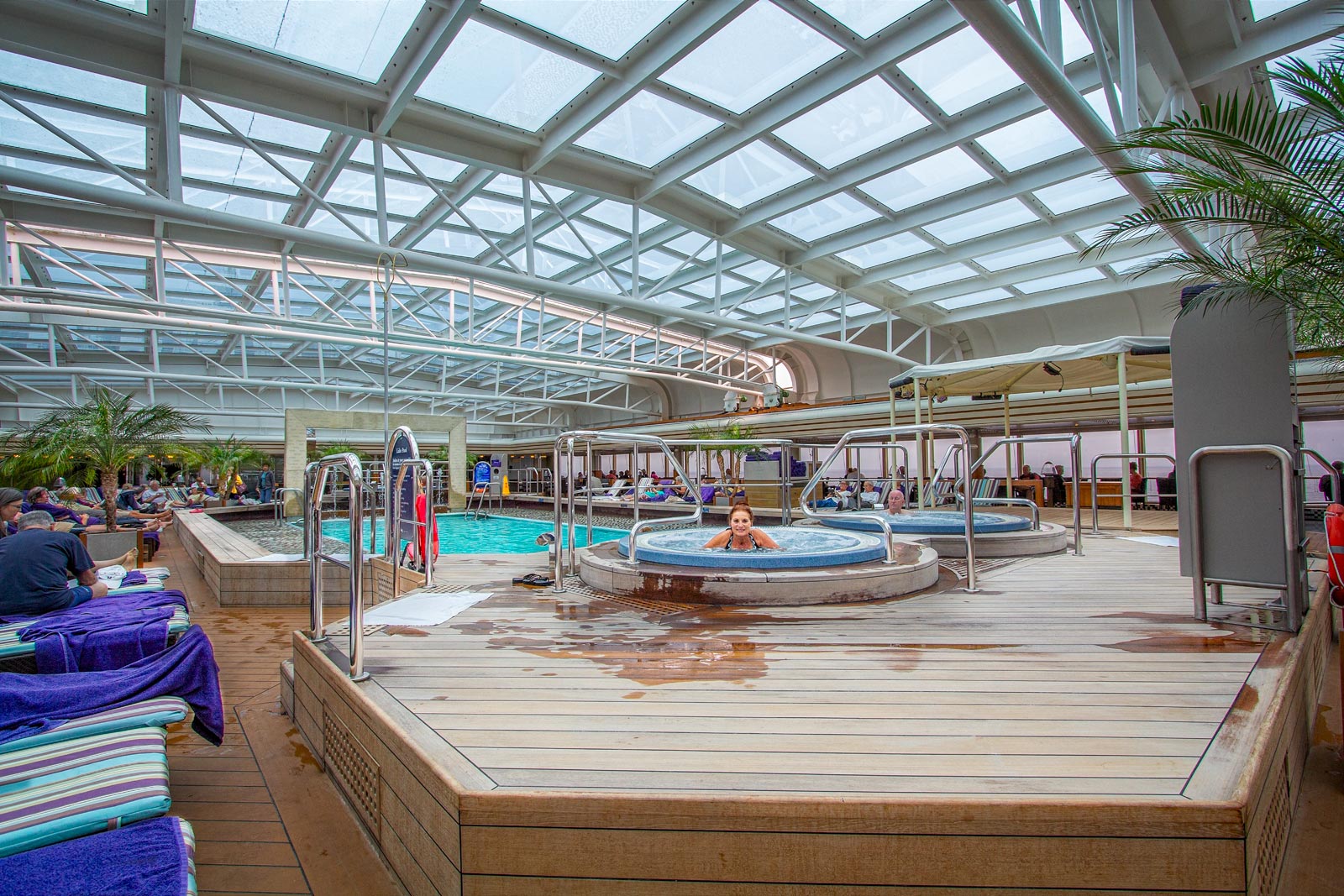
On a “Sea Day” Susan’s routine is pretty well fixed. She goes to the gym for at least two hours, lunch, and then to the pool deck. Here she is in the hot tub. Me, I am not so keen on swiming pools or hot tubs I have to share. Notice the wide field of view in this picture. This is the advantage that a wide angle lens gives you.
Since we have already had a tour of the ship I though that today we could discuss travel photography. In particular, I felt it might be interesting to discuss how I took these pictures and what equipment I used. This will not be a course on photography, it will not tell you how to use your camera, and it is certainly not for a photographer at the professional level. I know this could be a dry and uninteresting chapter for many so I will try extra hard to make it interesting.
Why take Pictures at All?
If you look around you at the people you are travelling with you will notice that very few carry cameras any more. Many do not concern themselves with pictures at all and those
that do are using cell phones or tablets. And this brings up the subject of what you want from your pictures, if anything. Before you leave home you should think about why you would want to take pictures. Just because some of us obsess about photography that does not mean that you are obligated to take a single image.
There is a great sense of freedom when you experience your trip without being worried about saving pictures. There are always postcards, books about places you visit aimed at the tourist, and on the ship, there is a good photo service where you can have portraits taken and printed. For many this is all they need and I understand that completely. There are days that I leave my cameras at home and I know that is a liberating experience. I also know that I regret it every time as inevitably I will see beautiful picture just crying out to be saved. That is the curse of the amateur photographer.
The majority of those who want to take pictures want images of themselves on their phones or tablets to show friends back home. Maybe they want a few 4″ x 5″ prints which the smart phone camera can handle easily. And this is a perfectly legitimate use of photography. If that is all you want, don’t burden yourself with a camera or any of the gear that goes with it. Don’t envy those of us with the fancy cameras. They are heavy and they make our necks hurt hanging there. Travel light and enjoy it.
Cameras and Gear
There are some of us who love taking pictures. There is some question as to why we are so afflicted but for me it is such a love of life that I want to collect as much of it as possible to savour
later. Pictures have this amazing ability to evoke memories of a place or time that one did not realize they had. These are memories not only of the place but of smells, sounds, even feelings. For instance, this travelogue is a trip down memory lane for me and I am recalling things that I had long forgotten.
So what were my plans for my pictures? This is an important question. You should not carry more camera than you need. Well, I like to make books with my pictures. Just self published books one copy at a time but I love them. I like to display my pictures on my website and I do make prints up to 13″ x 19″ and occasionally larger. So I want a high resolution camera. One that will give me lots of options later on.
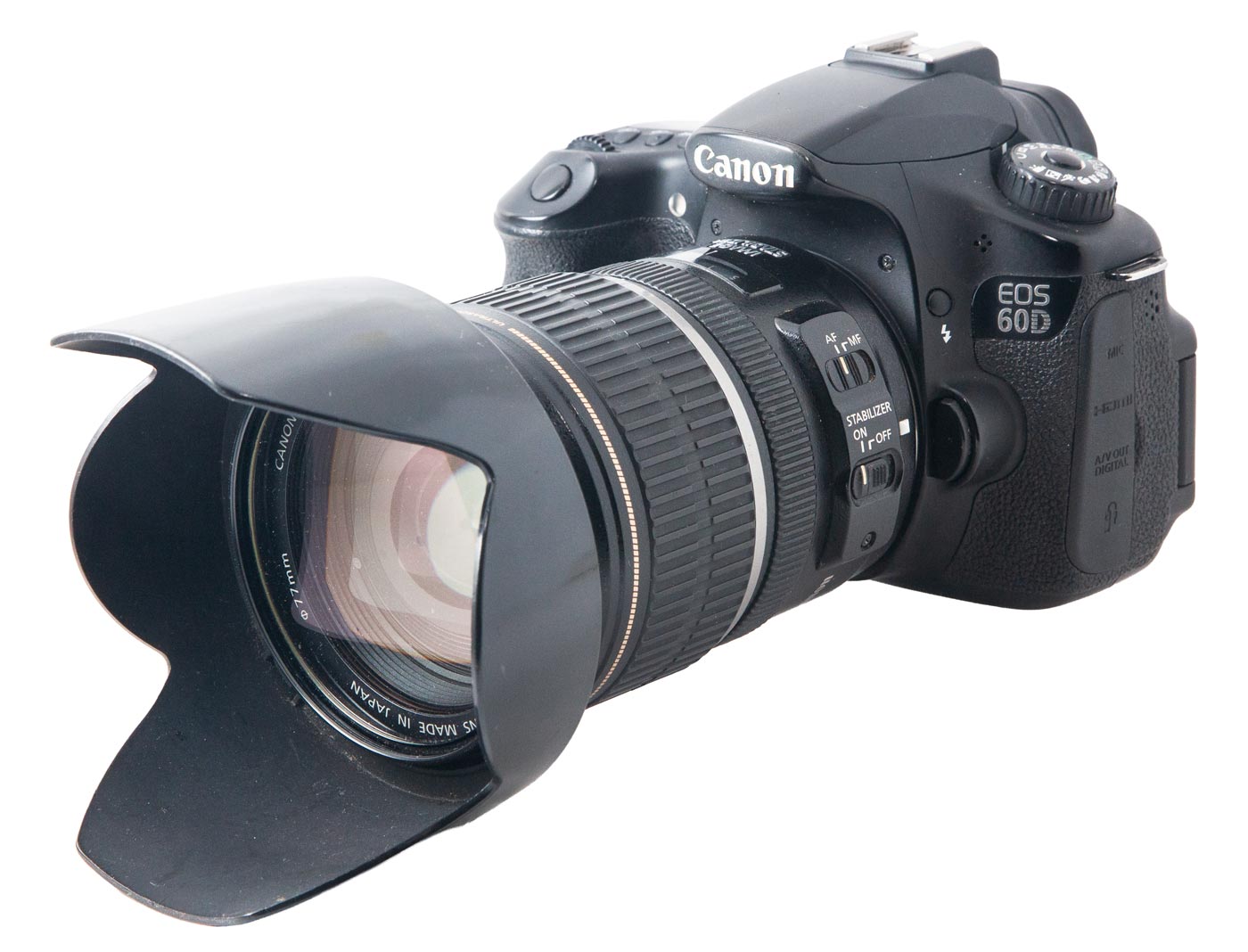
This is my Canon 60D
with the zoom lens I used for most of
my pictures on this trip. The lens is an
EF-S 17-55mm f2.8 zoom lens which I used
most often on this trip.
My Camera
In 2012 my “go to” camera was my Canon 60D which I had bought new a
year earlier. Although I have bought two more modern cameras since this 60D is still a workhorse for me. Most of the camera and lens images on this website have been taken with it.
This camera has an 18 megapixel sensor which is capable of making fine prints of up to 13″ x 19″ and even up to 18″ x 24″. Not only that but this camera has decent low light abilities and enough features to allow me to be as creative as I wish.
The lens that came with the camera was excellent but I opted to upgrade to an EF-S 17-55mm f2.8 lens that promised sharper images and larger aperture. Being a zoom lens it was flexible enough for most of my pictures. The larger aperture allowed me to take pictures in lower light situations which is a distinct advantage if you are in churches, historic buildings or even cruise ships.
Lenses
The EF-S 17-55mm lens we have already discussed is ample for the less fanatical photographers amongst us. It will take wonderful pictures from reasonably wide angle to almost telephoto which is usually enough.
However, for the more fanatical amongst us extra lenses are essential. Now, the mistake most people make is thinking that the best extra lens is a telephoto. This, however, is not true. Travel photography makes much more use of wide angle lenses. Walking in city streets, taking in large buildings, capturing the interior of cathedrals, you need a wide field of view. It is essential to capture the “feeling” of a place.
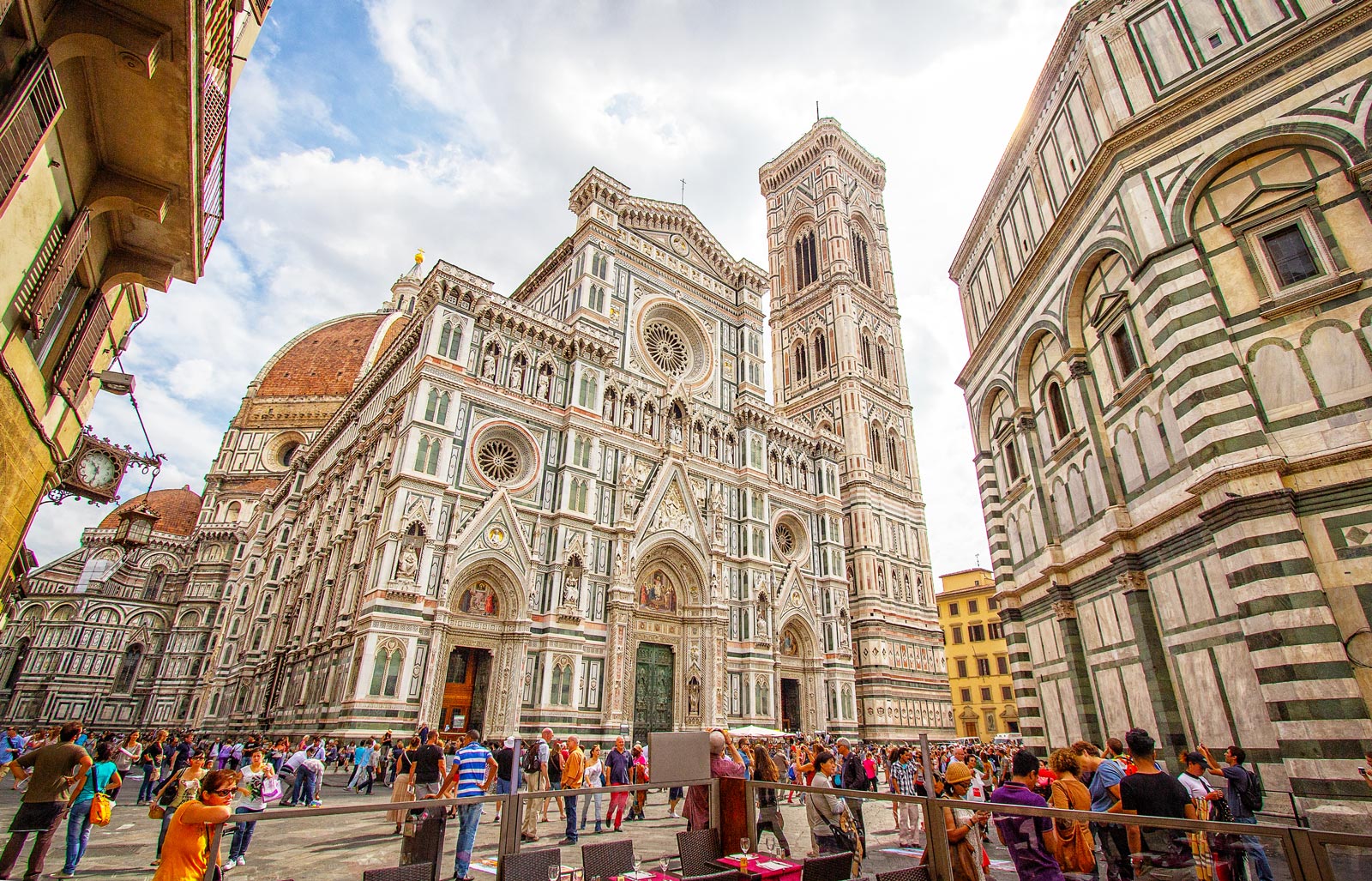
Anyone who knows the piazza in front of the Santa Maria dei Fiore cathedral in Florence knows how small the space is and how impossible it is to get back far enough to take an effective photograph. The answer is a wide angle lens. Consider the photograph on the right taken on another day on a different trip. This is the Cattedrale, the Battistero and the Piaza between them in the city of Florence.
The buildings are distorted. This is a common feature of a wide angle lens. I have left the distortion uncorrected because I think it emphasises their size and the intimacy of the space. This is a classic use of a wide angle lens. No other type of lens could have done this.
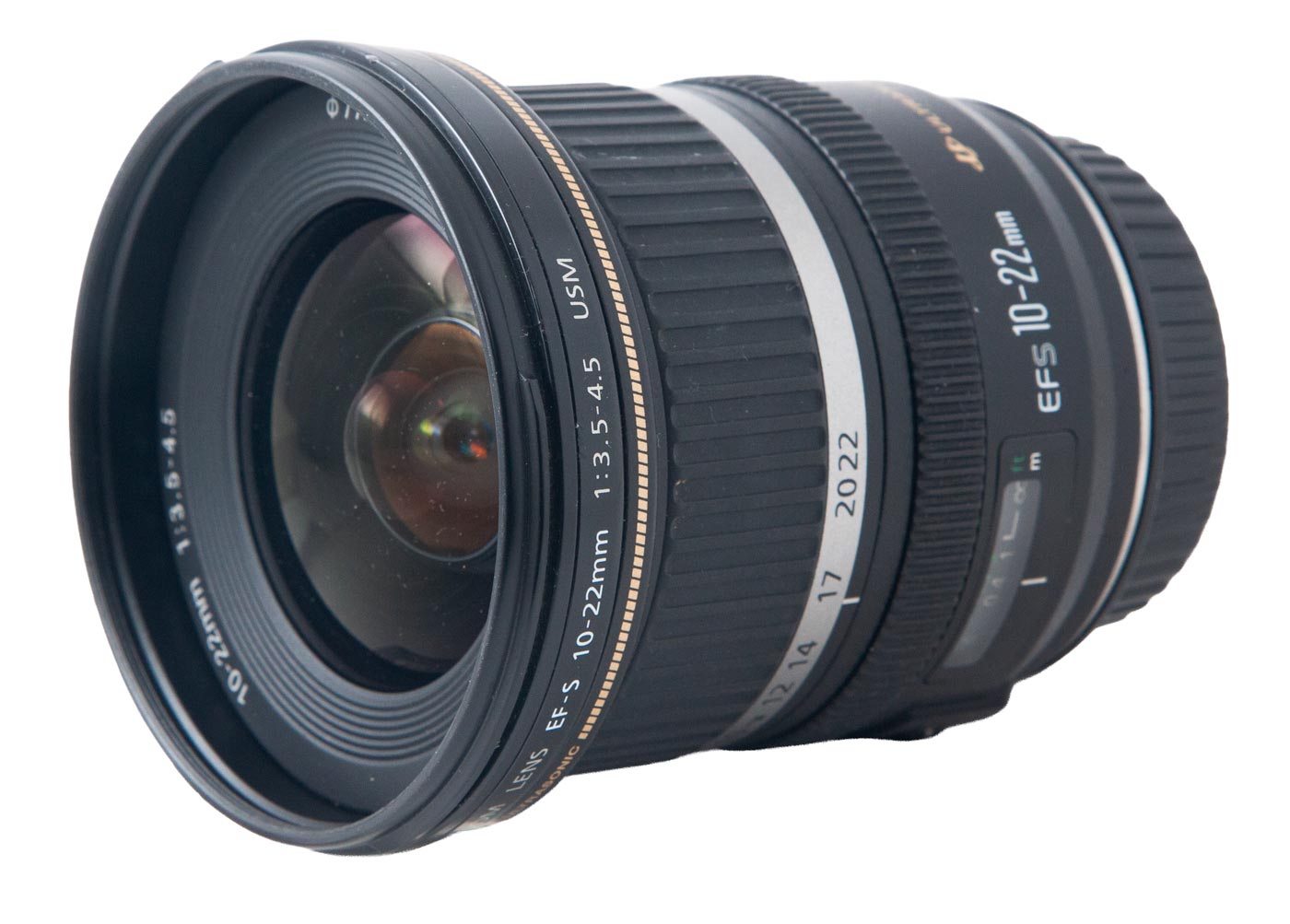
This is the Canon EF-S 10-22mm f/3.5-4.5 USM wide angle lens that I carried on this trip.
This is a most excellent lens and that is why I chose it. I had taken it on several trips and it always gave me wonderful images, but, it weighed more than my camera and other two lenses combined. And it was big and bulky. When you travel you want to be mobile and not break your back carrying your equipment.
There are smaller lighter lenses that will do the same job. Yes, they may not deliver the same quality of image but there are no “bad” Canon lenses. I should have chosen a more compact and lighter lens such as the EF-S 55-250mm f/4.0-5.6 IS STM. All of that said, and as you will see, the lens I chose did give me some wonderful pictures.
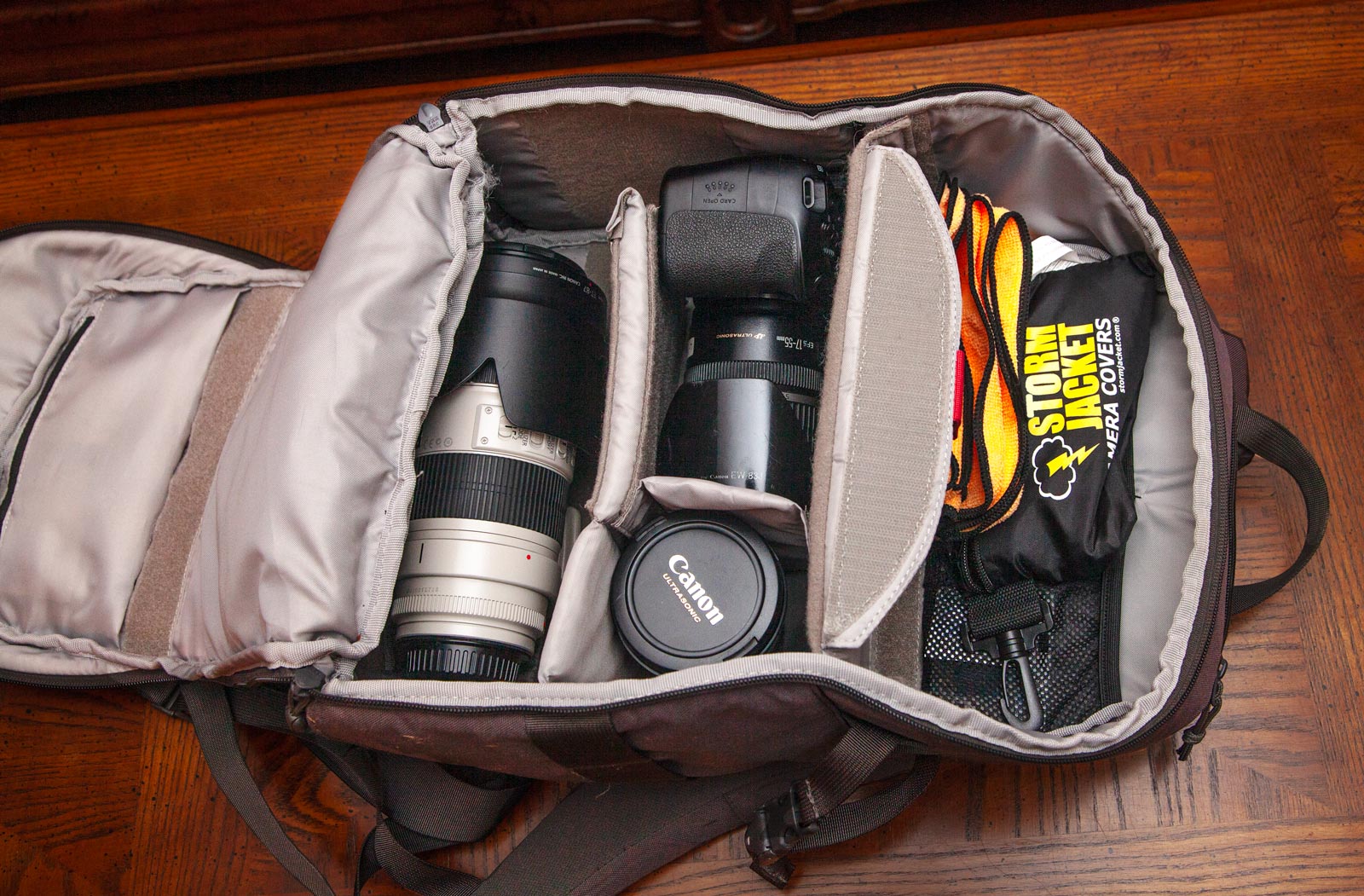
This is my Lowepro backpack which has travelled the world with me. And it is still as good as new. It normally is full to the brim but here you can see the camera gear. On the left is my EF 7-200 mm lens, in the center bottom is the wide angle EF-S 10-22 mm lens and at the center top is my 60D with the 24 to 70 mm normal zoom. The big compartment on the right gets full of all kinds of stuff, which we’ll discuss.
The wide angle lens I took on this trip was the EF-S 10-22mm f/3.5-4.5 USM from Canon. This lens couples to the camera giving seemless auto focus and automatic exposure. This is a decent lens at a modest price and certainly adequate for our travels as you will see.
I did carry a telephoto lens as well. And this is where it gets interesting because my choice was a mistake. I chose to carry my Canon EF 70-200mm f/2.8 IS II USM. Quite a name for an truly excellent lens. But it is large and very heavy. And that is the problem.
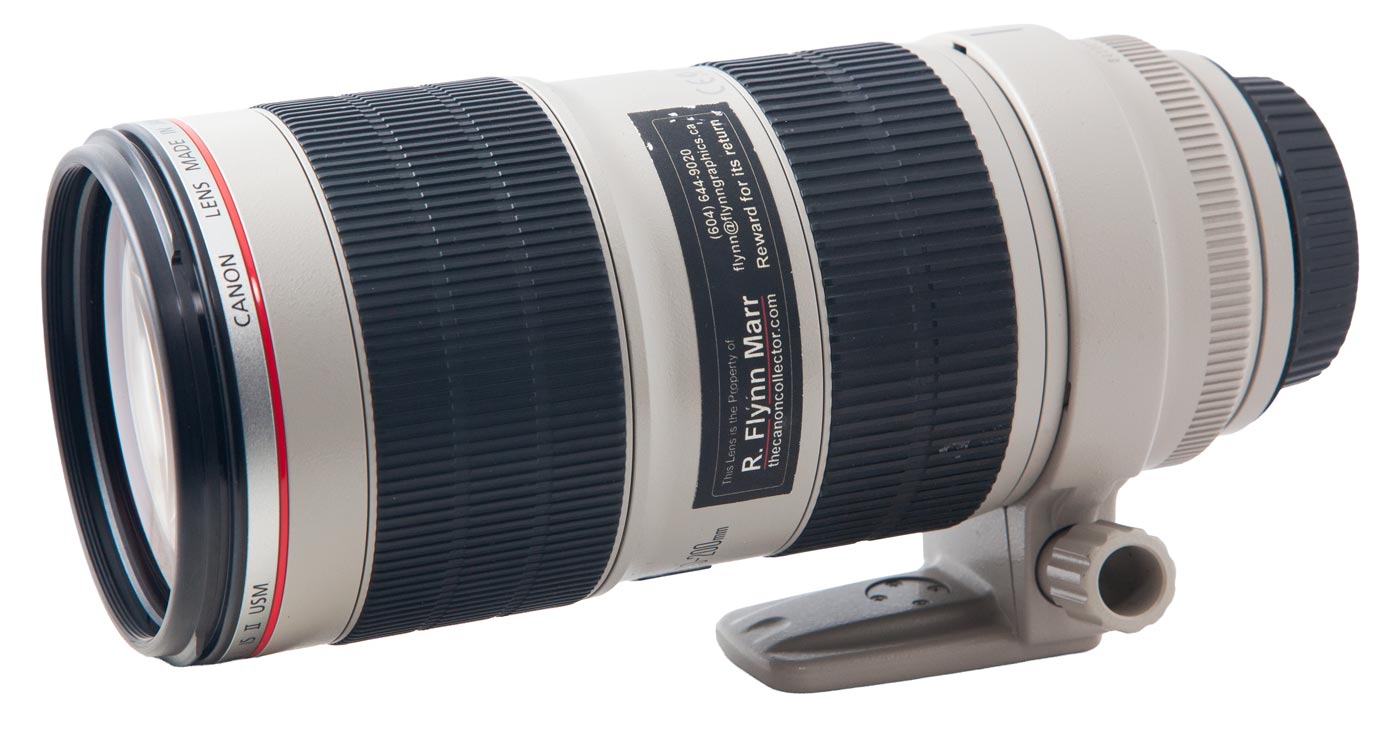
This is the very large and very heavy Canon EF 70-200mm f/2.8 IS L II USM. Note the label identifying the owner. Do it to all of your gear.
But, you say, how did you carry all of this on the plains, trains, ships and automobiles? Well, there was more than this which we will get to shortly. And it was all carried in a backpack small enough to be hand luggage on a 747.
It is a Lowepro bag and I have had it so long I have long forgotten the model. It is well padded with lots of dividers and pockets. There is a pocket for my laptop and there are straps on the side for my travel tripod. It fits in the aircraft’s overhead bin or under the seat in front. And with its padded straps and waist strap it is comfortable to wear, even for long periods.
One more thing: put your name on the bag with indellible pen. I have my name, e-mail and cell phone number on the back between the straps. Label all of your gear. If you lose it you will likely not get it back, but, you never know. There are some honest people in the world.
Using it daily it was never full. Wherever we stay I unload it and only carry with me what I anticipate needing for the day. Often I just carry the camera and one lens. The backpack is an essential piece of kit.
The Bits and Pieces
So we have discussed the camera and lenses but that is not all that I carry. There are many other smaller bits and
pieces that are important as well and that we should touch on. For instance, the camera needs Batteries. So I carry the charger and at least two batteries. I like to have one in the camera, one fully charged in my pocket and one at the hotel in the charger. Those accessories are pretty obvious.
Filters and Lens Hoods are essential. The day you buy a new lens put a skylight filter on it. And don’t skimp on the cost because you want optical glass with a decent lens coating on it to reduce reflectons. You do not want to clean your lens’ front element any more than absolutely necessary. If it is protected by a filter you should never have to clean it. You clean the filter. The filter also protects the lens surface from finger prints, sand, dust and being hit by foreign objects. It is cheaper to replace a filter than buying a new lens!
Lens hoods are also very important. Firstly they protect the lens from stray light coming in from the side. This light can flare in the lens and reduce overall contrast. But even more important, the lens hood keeps your fingers off the front element, which should be a filter in any event. Also, if the camera swings against a door frame or pillar, the hood will absorb the impact. It may break but it will save the filter ring and front edge of the lens from the impact. Look at the picture above of my 60D. That lens hood is great physical protection for the lens. Again, a new lens hood is cheaper than a new lens!
I used to carry a Tripod when I travelled. Not now. I have a nice Giotto travel tripod, light weight, sturdy, and really good quality. But I find I don’t use it. Firstly, many places where you might want to use it, cathedrals, museums, piazzas don’t allow the use of tripods as they represent an obstruction and trip hazzard for pedestrians.
Lately I have been carrying a Monopod which helps steady the camera and I use it as a walking stick. But on this trip I did carry a tripod.
While you are travelling every day is not sunny even though you wish it were. But that is no reason to stop taking pictures. Rain is part of life and colors come alive in the rain, the mist is wonderful moody, and life goes on. But you must be prepared for it.
Look in the photo of my backpack. In the compartment on the right hand side and you will see my Storm Jacket. That is the name of this particular product but there are other makes out there. It slips over the camera and lens and keeps them dry when out in the rain or where there is ocean spray. I was using my Storm Jacket when I took the picture on the right on another trip in 2014.
I also carry Lint Free Cloths to wipe my gear and keep the lens free of water droplets that will reduce the contrast and blur your images. I also carry Lens Tissues and Lens Cleaning Fluid. Well, actually I just buy isopropol alcohol and use that: just as good and much cheaper.
And what else will you find in my kit. Lens caps for the lenses to protect them when not on the camera. Polarizing filters to reduce glare and reflections and deeped the colors in the sky. You will find pencil, paper for notes, and business cards. That’s about it.
Protecting your Images
This we have to talk about! One year Susan and I took a cruise through the Panama Canal. A wonderful experience and I took lots of pictures. At the time I was using my first digital camera, a Canon Rebel XTi. When I got home I transfered all of my pictures to the hard drive on my computer and formated my Memory Chips. But I made a mistake. My only copies of my pictures were now on my hard drive. I then connected an external hard drive to back up my images but when I pressed the copy button I heard a terrible grinding sound from my computer and it stopped recognizing my hard drive.
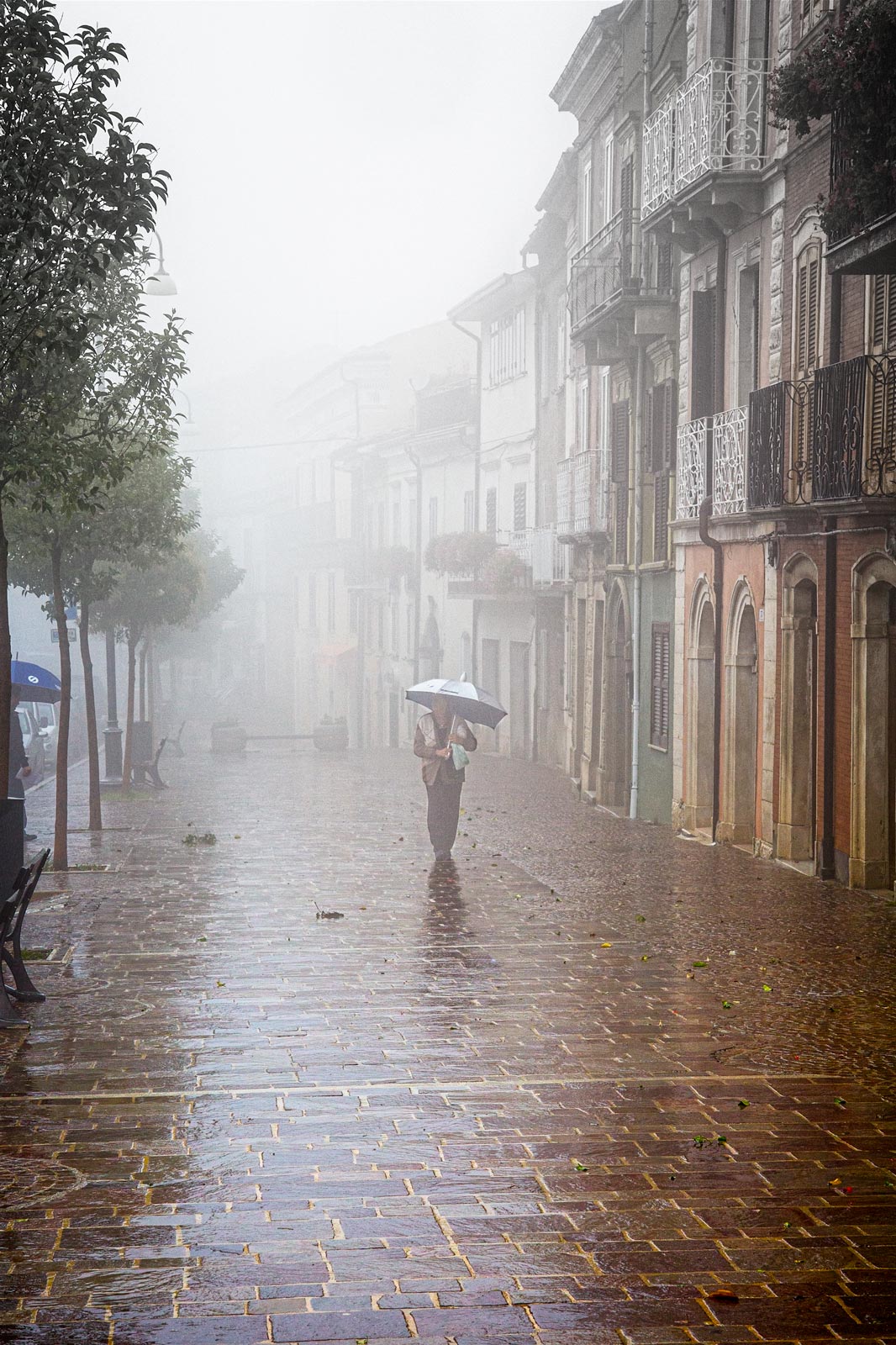
It does rain on vacation. This street in Torricela Peligna in Abruzzo, photographed in 2014 on another trip, is beautiful in the rain. But you must plan to protect your camera.
I tried everything I knew to access the drive without success. I contacted a data recovery company in the USA and sent them the drive. They said that the heads had crashed on the disk surfaces and gouged them so badly that there was nothing they could do. All of my pictures were lost! So how do you protect against this?
I have a system I use. First, I carry more than enough memory chips to save all of the pictures I take. I carry them in a waterproof case like the one on the right. Notice that some of the chips are top side up and some are top side down. When I start out all chips are empty and top side out. As I fill the chips they go back in the case but I place them top side down so I don’t overwrite anything. And while on the trip I do not erase any files from my chips.
OK. So far so good! I carry a laptop with me and an external hard drive. Among other things, every evening the laptop allows me to copy the days pictures to the hard drive. I create folders on the drive named for the days on the vacation so the pictures are organized by day.
Once the files are copied to the drive I then have two copies of each photograph. Then when I get home I copy the files to my desktop and then back them up again. Only then do I format my memory chips. After I confirm my backups on my desktop computer I can then overwrite the files on my external hard drive. And that is how I make sure I never lose all my files again.The principal is to never have a single copy of your files on a single medium.
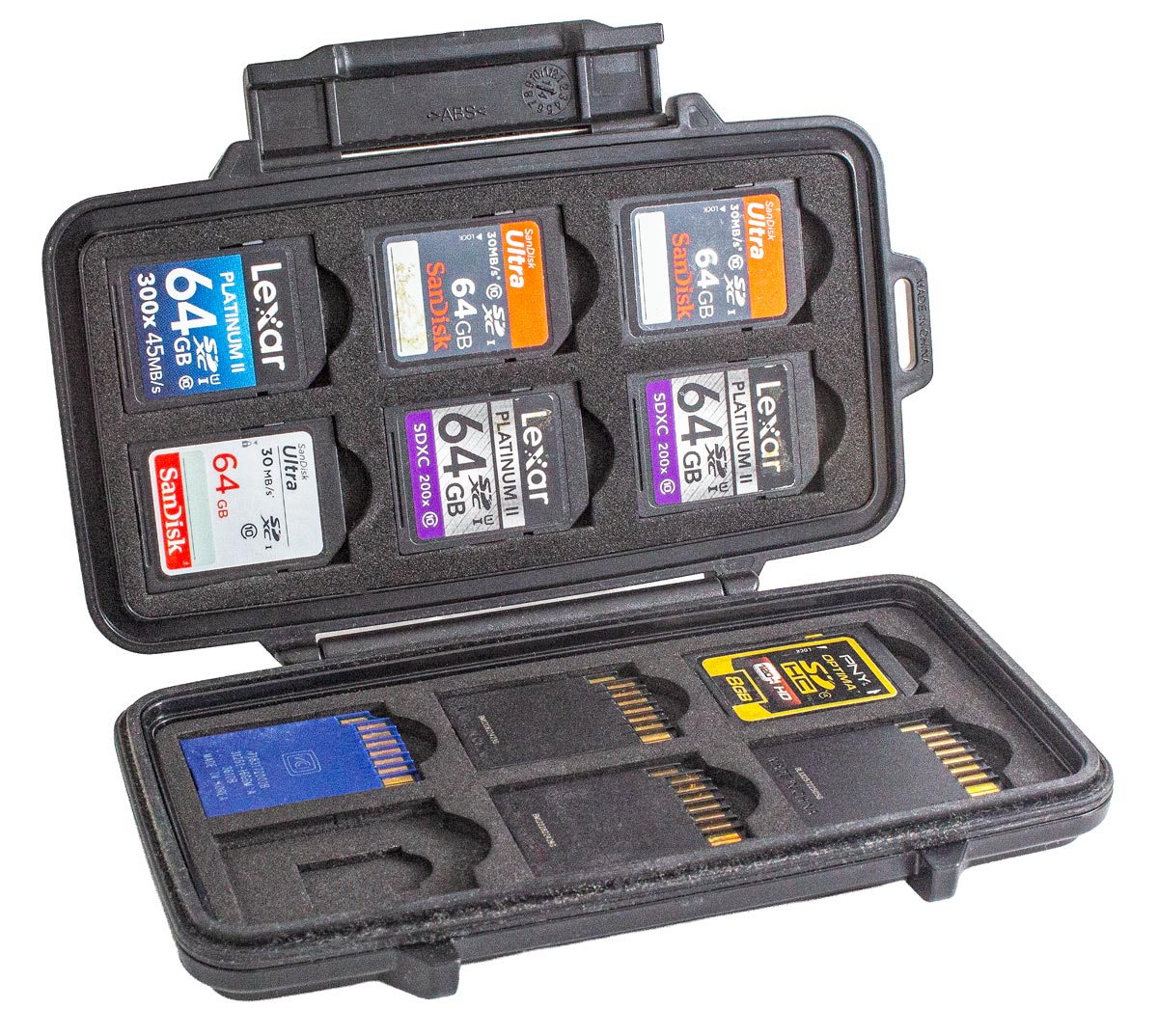
This is my Pelican waterproof memory chip case. It easily holds enough memory for a summer’s worth of pictures. Notice some chips are top side up. These are empty and ready to be used. The top side down chips have images that are already backed up by my laptop so that I have two copies at all times.
And there you have a rundown on how I take these images. It is not about how to take good pictures but rather the physical process of capturing the images you want and getting them home safe. No magic. Just careful planning.
So, get to bed early tonight. Tomorrow we spend walking the streets of Helsinki!
This website is the work of R. Flynn Marr who is solely responsible for its contents which are subject to his claim of copyright. User Manuals, Brochures and Advertising Materials of Canon and other manufacturers available on this site are subject to the copyright claims and are the property of Canon and other manufacturers and they are offered here for personal use only. Use of this website is governed by the Terms of Service set out on the page by that name.

The True North Strong and Free