
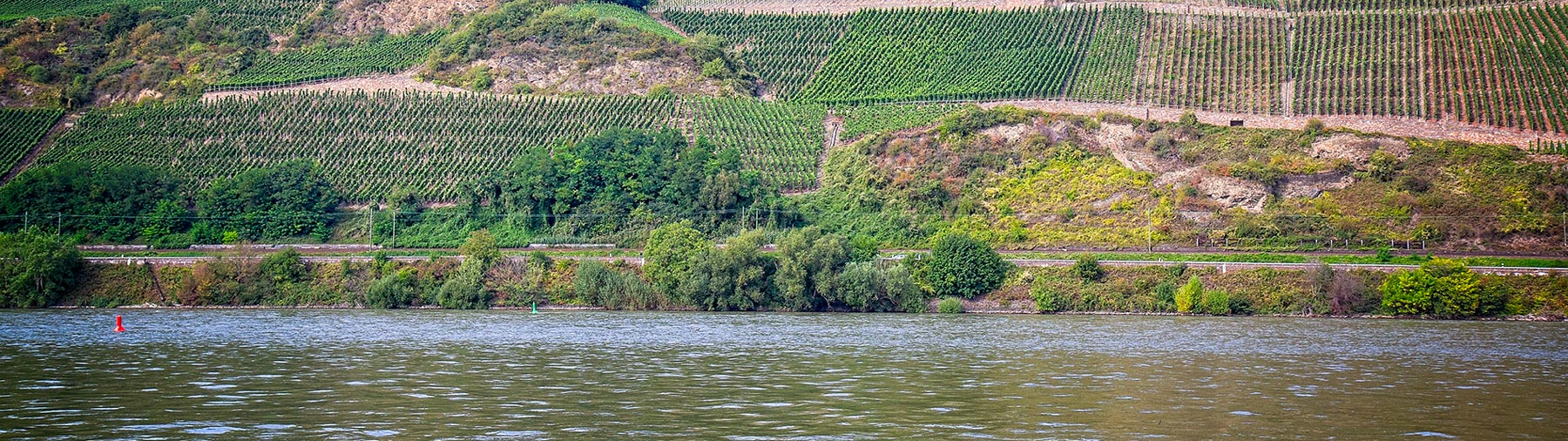
The Rhine River
Flynn Marr 18 October 2026
Sorting through my images from our 2012 trip through Europe has been a frustrating exercise. I find myself wanting to show you everything, to post picture after picture saying look at this, look at this, look at this. Of course I see different things in my pictures than you do for every one holds a memory which evokes an emotion for me. You will miss all of that subliminal content unfortunately but I have tried to chose pictures that will inform but not overpower the viewer. But what is here is a small fraction of the pictures I took.
When judging a photoraph we have to take into account the point of view of the viewer. This will be hard sometimes but we have to do it to create a sustained enthusiasm for the images in the presentation. So remember, what you see here is not an historical document but rather taste of an experience. But it does frustrate me because what you see here is a small fraction of the images I captured on our trip.
Since the advent of digital photography we have been freed from the need to conserve our film. The pictures are now essentially free and you can never take enough pictures. I promise that when you get home, it will not be enough. So take pictures of everything. Well, there is one caveate. Don’t let the picture taking spoil the experience. Seek a balance.
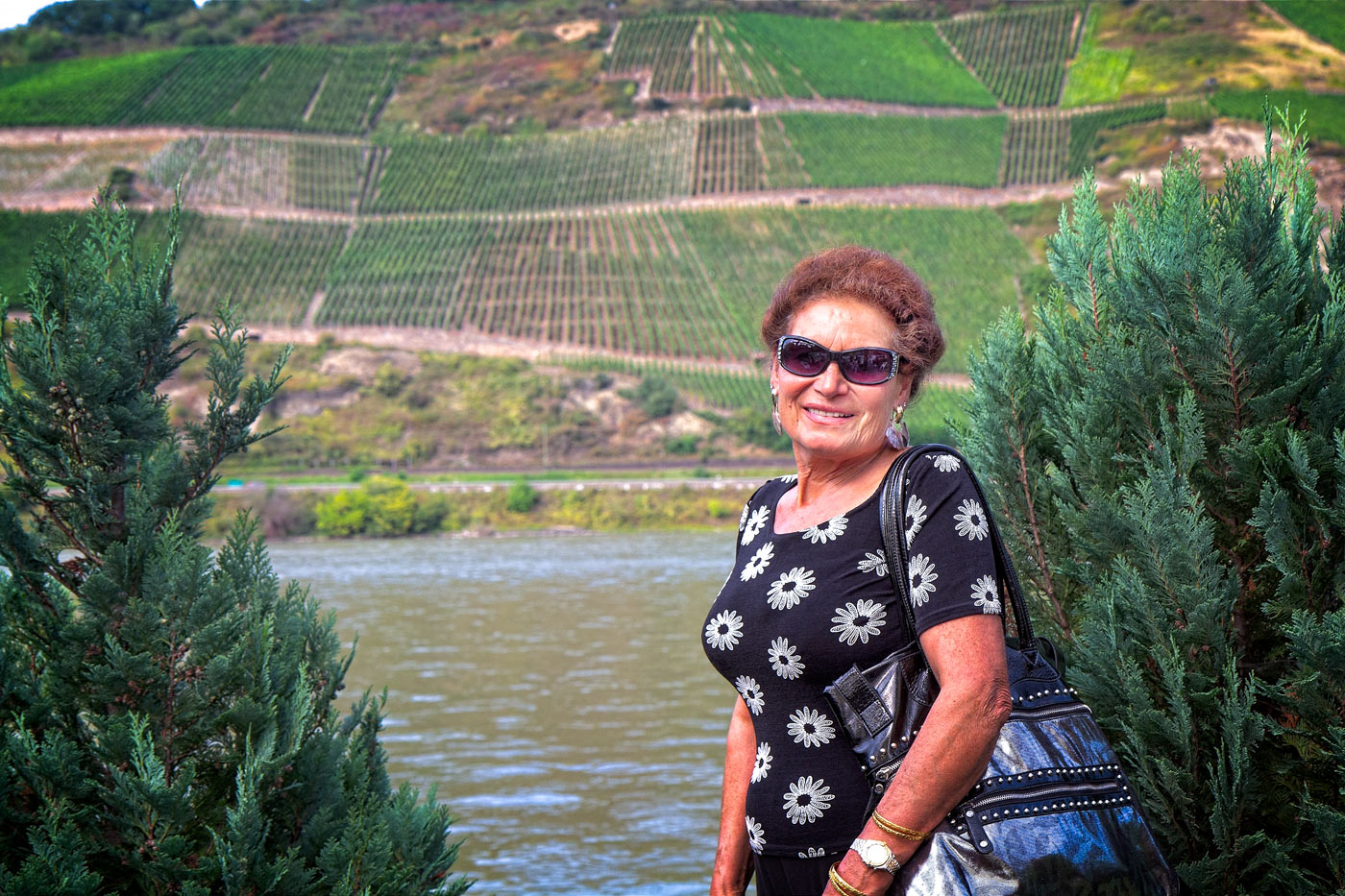
Susan with the River Rhine in the background. And across the water on the hillside you can see the vinyards that produce the famous Rhine wines.
In the last post I left us in Korback at the Hotel Touric. After an interesting two days in this picturesque town it was time to head south to Switzerland. We had a good breakfast at the hotel and then packed the car and headed out.
We drove south out of town and then south-west with only a rough plan to find the Rhine River. We stayed on two lane country roads and took our time. The highway wandered through rolling countryside dotted with small villages and towns with farms and forests between. It was as beautiful country as any you will find.
Eventually the lunch hour caught up with us and we pulled over in a forested part of the road and walked into the trees to have a picnic. Susan as usual pulled a meal out of her tote bag and we ate pannini sitting on a log listening to the sounds of the woods around us.
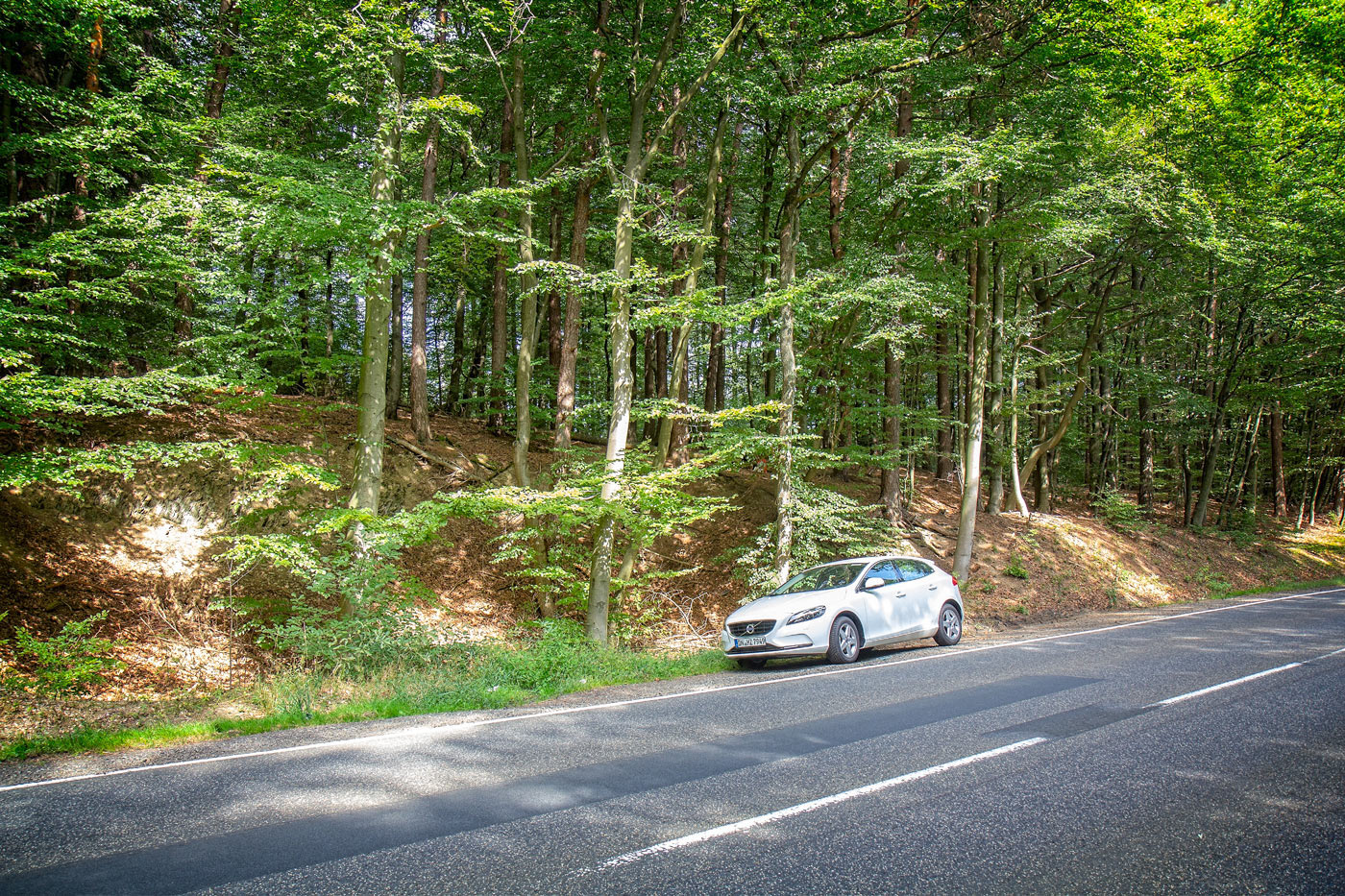
Mid afternoon we stopped in a rest area for lunch. As she always does, Susan had packed a lunch for us. She is amazing.
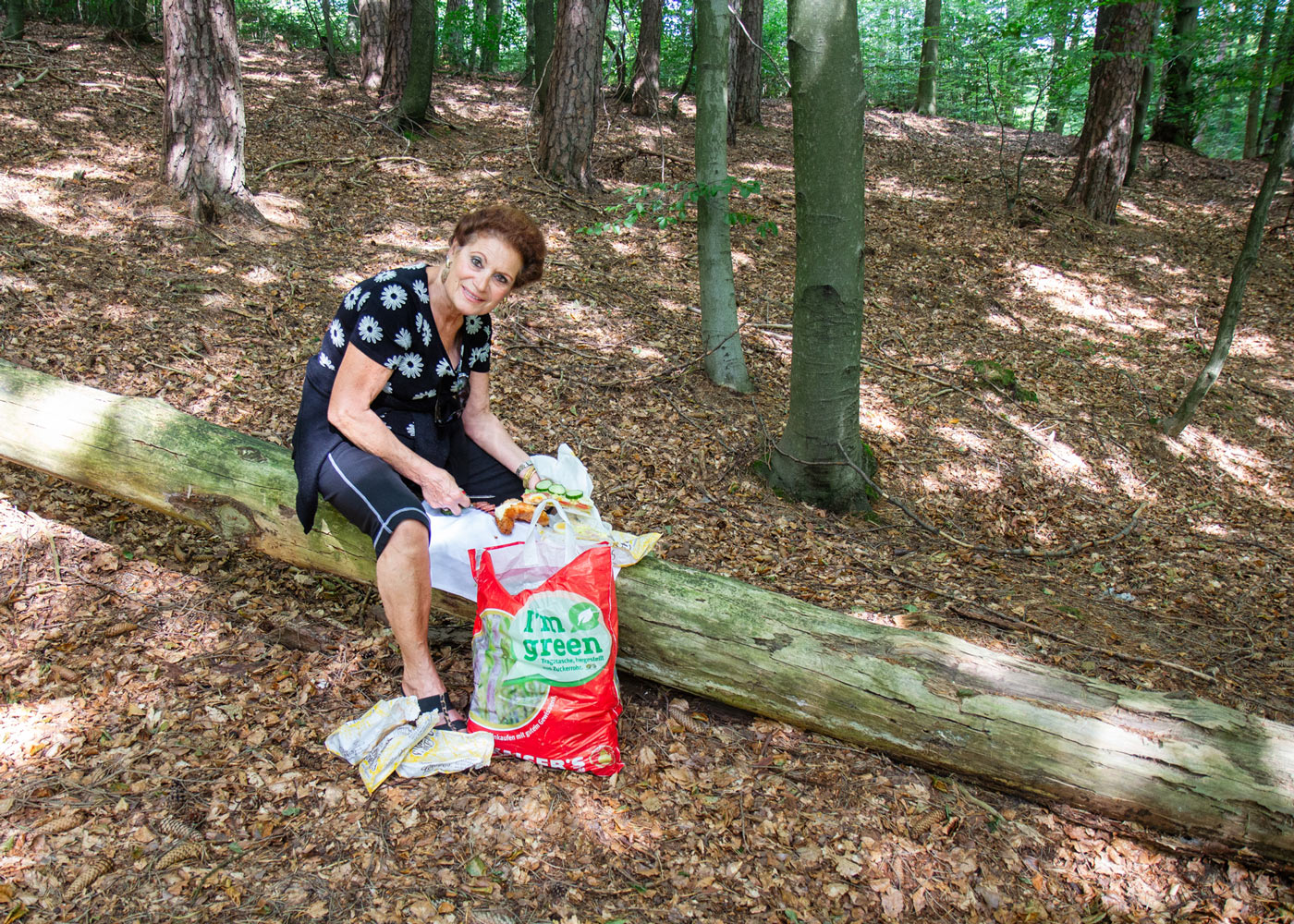
Susan’s lunches are always fantastic, tasty and healthy. Here we had croissant with cheese, tomatoes and avocado.
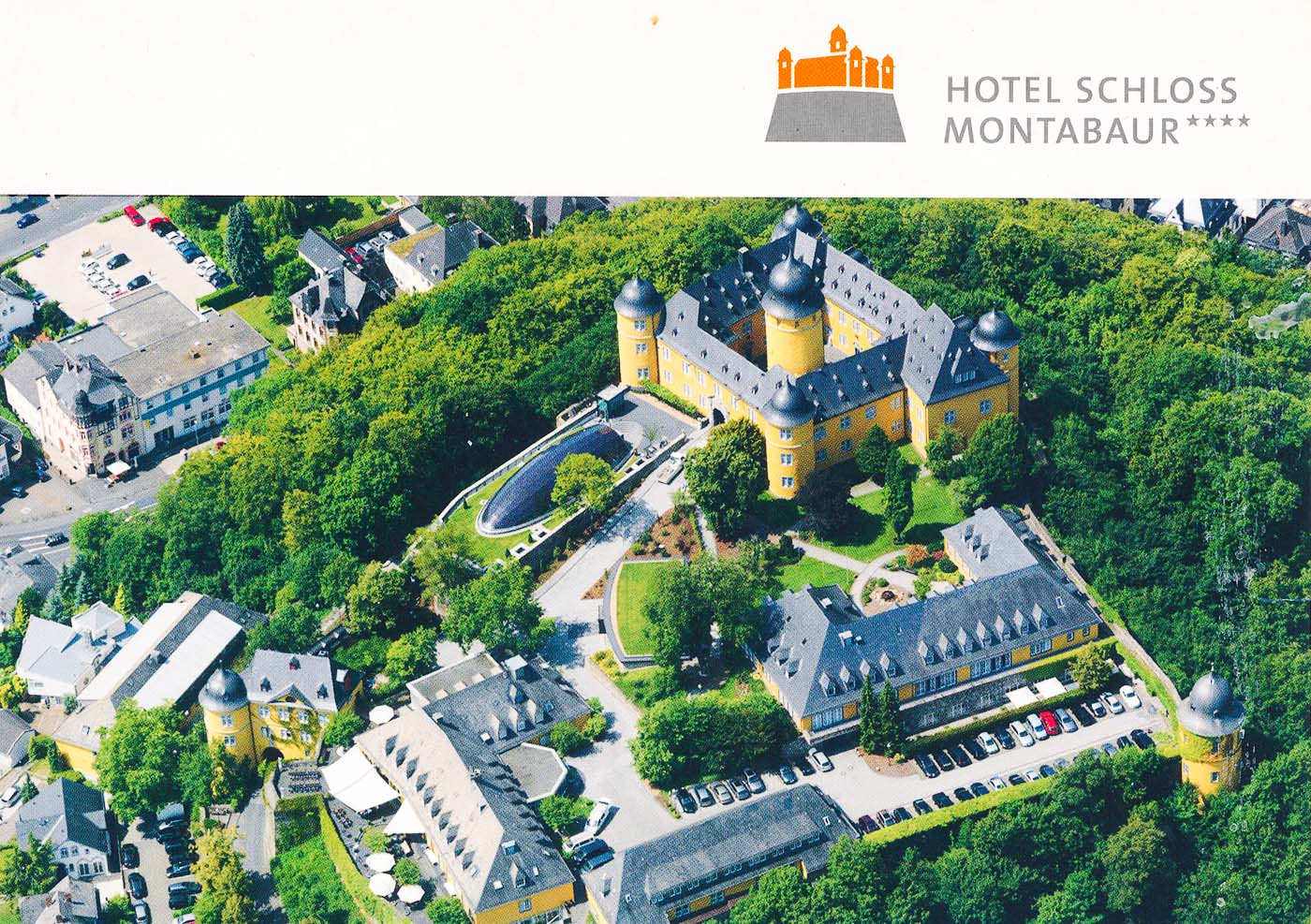
A post card I bought at the Schloss Montalbaur.
After our little lunch we set off again south west along what I believe was Highway 255 eventually coming to what appeared to be a large community. A sign as we approached said “Montalbaur” and further on another said “Schloss Montalbaur”. (Schloss is German for the English word Castle.) It was time for a break so we decided to have a look at the Schloss Montabaur.
References to this castle go back to the tenth century. The present structure was built on Schlossberg Hill in the center of present day Montalbaur in stages between about 1200 and 1600. Today it has been added to and restored to include a conference center and hotel.
We drove up to the parking lot and left the car to proceeded on foot. Walking is the absolutely best way to experince any location. There was a nice view out over the city but the site did not feel like its age. It was too modern for my taste, too much hotel and conference center and not enough castle.
We left the car where we parked it and walked down the hill and into the town. Montalbaur is medium sized town, city actually, with a very pretty historic center. We walked through the old buildings and crooked streets and looked in the shops along the way. Unfortunately it was late in the day and long deep shadows made photography problematic. It was getting late and we still had a ways to go so we walked back to the car and were on our way again.
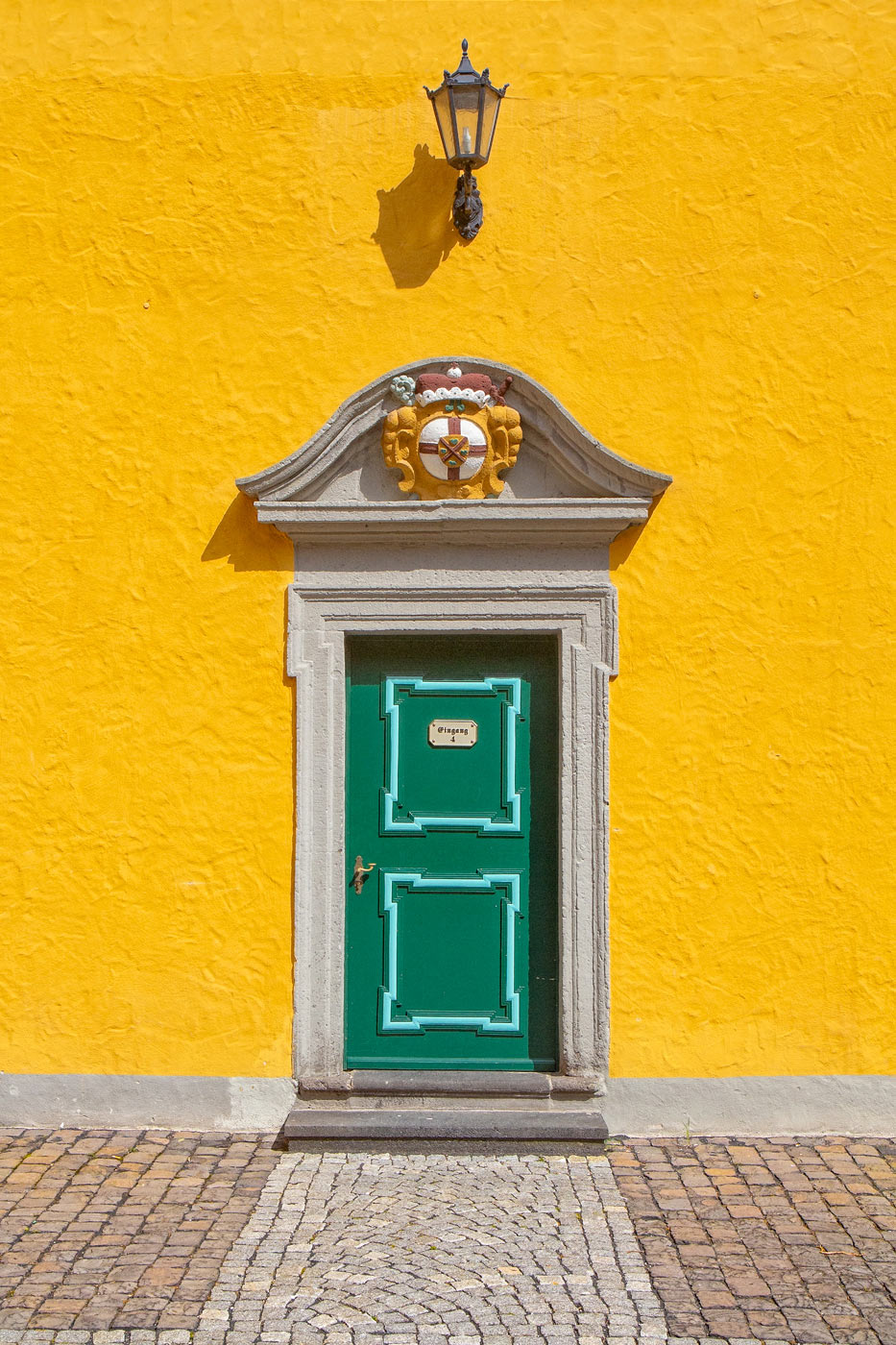
A simple doorway in a wall and yet I like this picture. It has color, symetry, and texture, all things that appeal to the human eye.
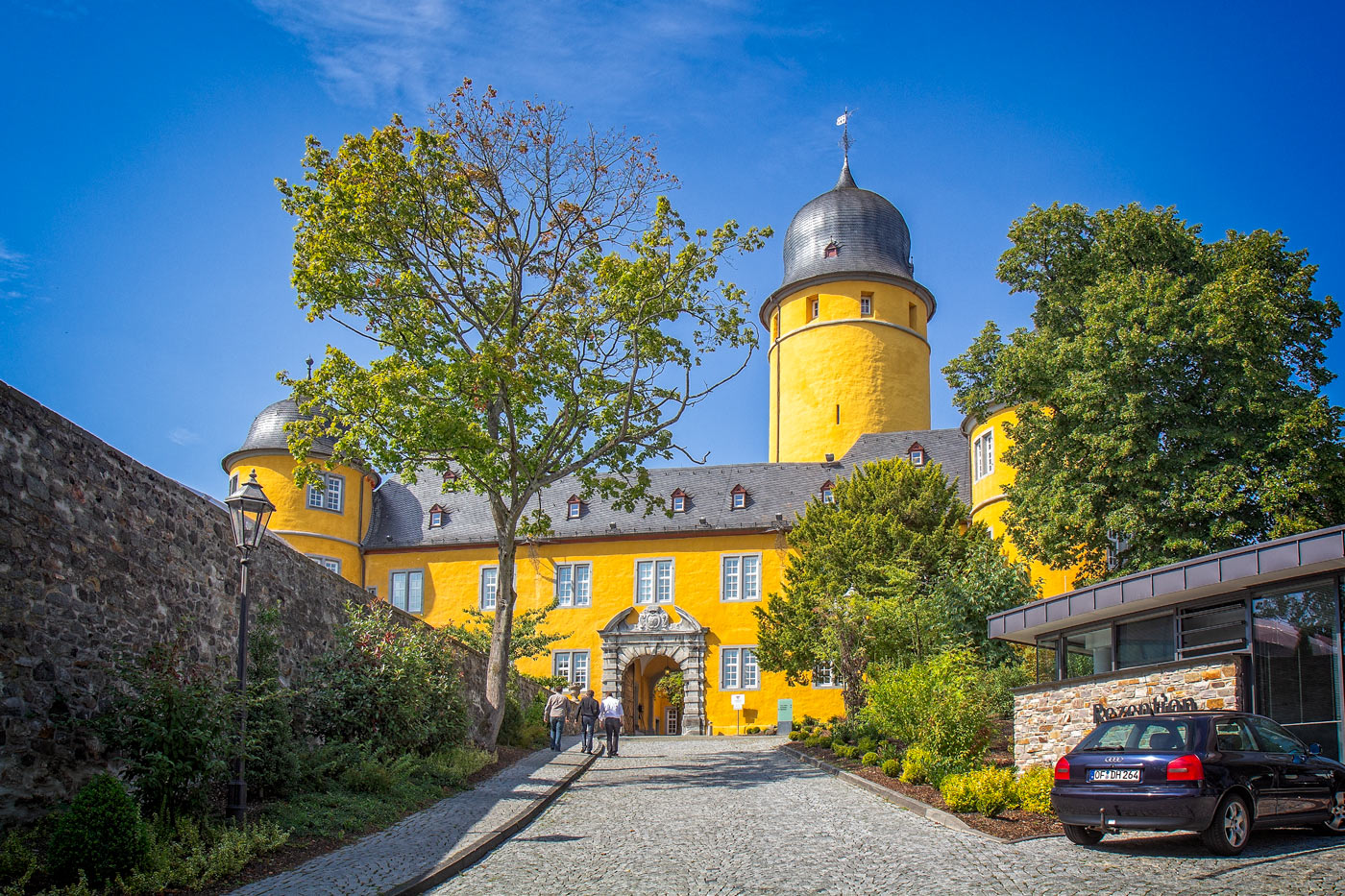
Walking up to the Castle Montabaur main gate. The restored castle has been converted into a very exclusive hotel and conference center.
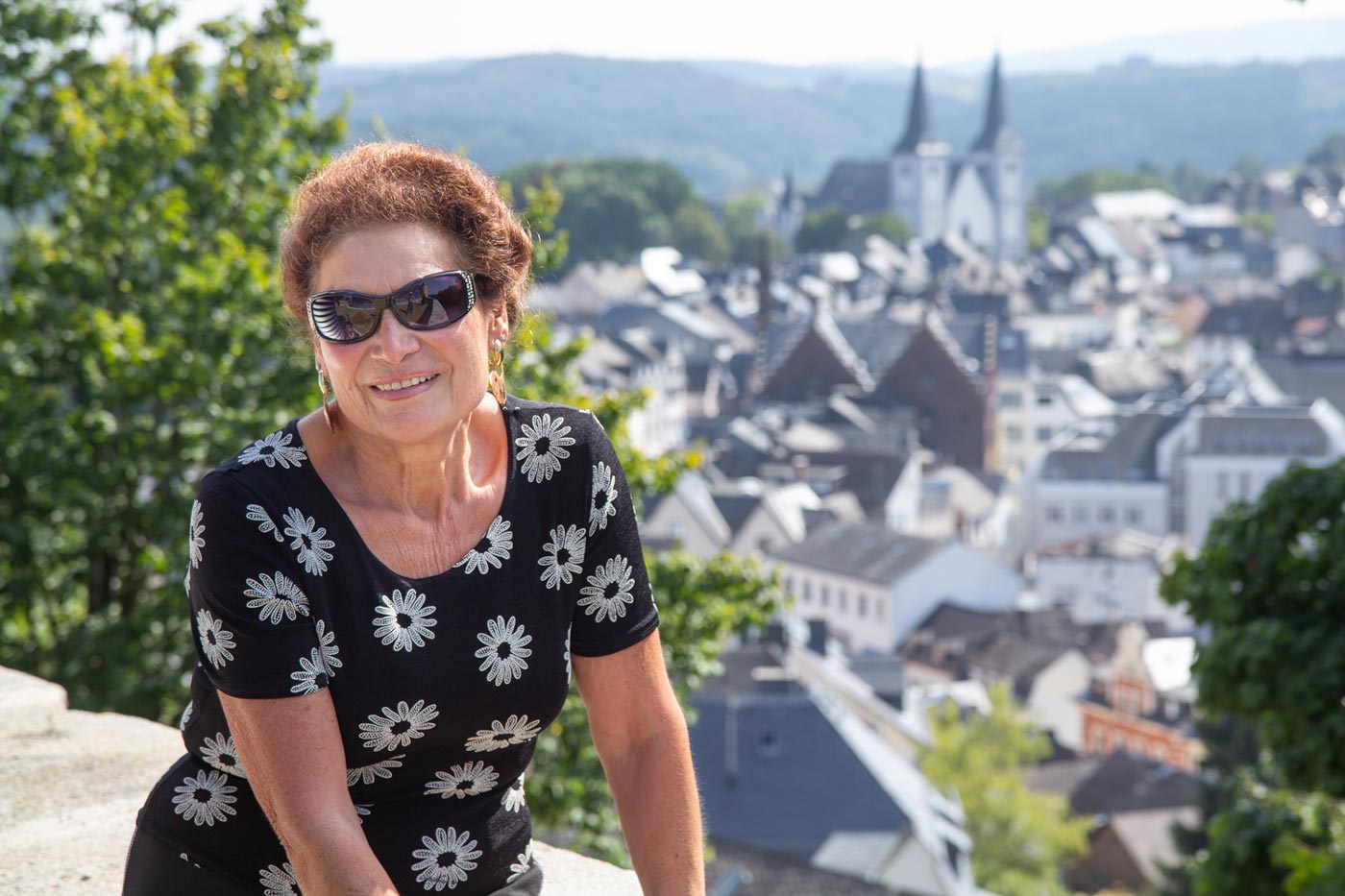
Susan is sitting on the wall of the castle with the city of Montabaur behind her. The building in the distance with the twin towers is the catholic church “St. Peter in Ketten”.
As a little aside, I love taking pictures. Various pictures can perform different functions. Many of the images here simply demonstrate our trip. Some are lovely and bring pleasure in themselves. And sometimes they are delightful all on their own regardless of our journey.
Occasionally I take a picture like the one on the left above that is irrelevant to our story but I like it very much. A simple doorway in a wall in Schloss Montabaur. It has color which is attractive. It has symmetry which all humans find attractive. And it is a decorated doorway. Taken together these elements create a pleasing image.
Now that is a very subjective statement. One man’s art is another mans waste paper. But for me, this is a great photograph.
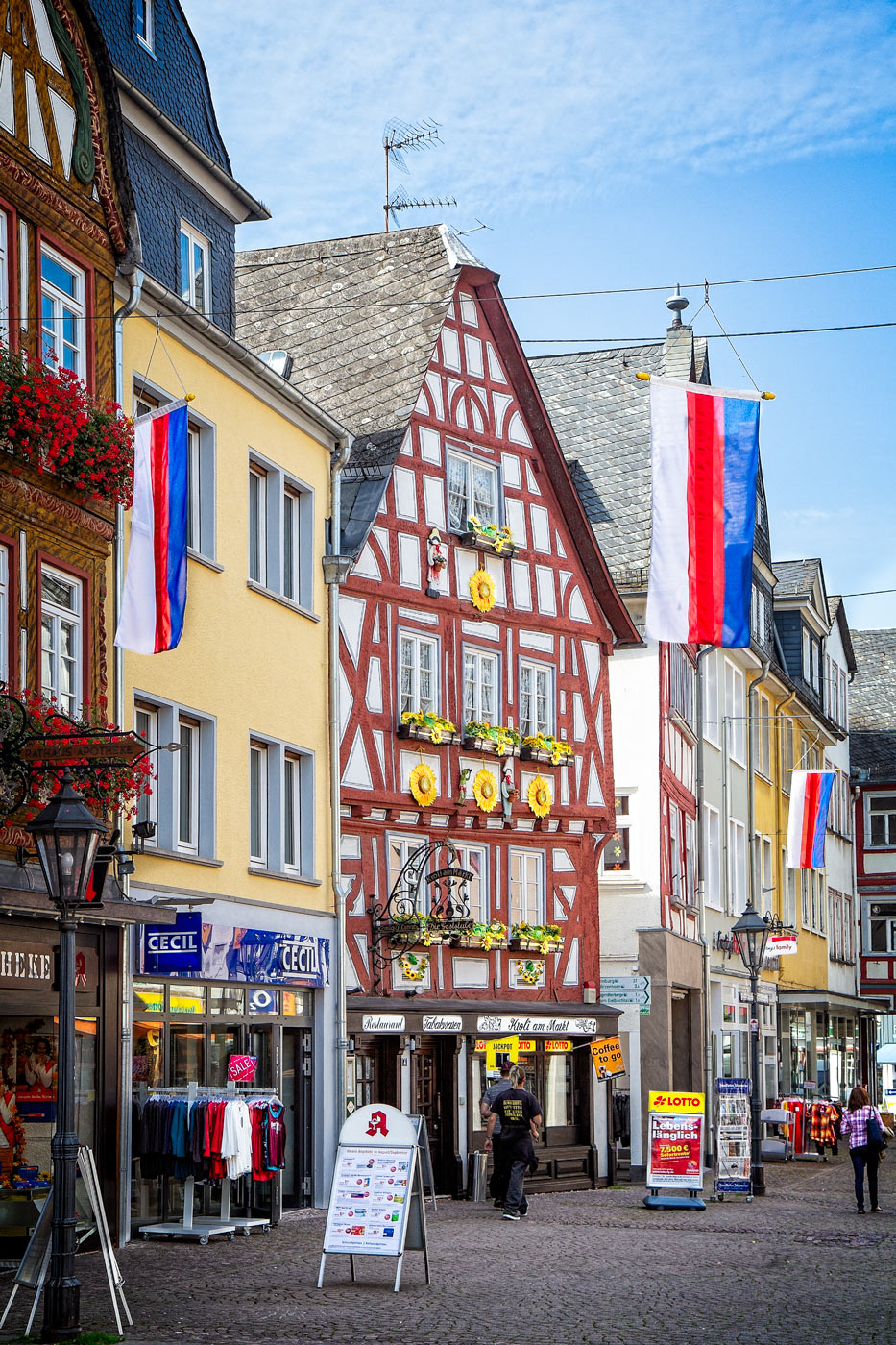
The streets of old Montabaur are full of traditional old buildings and shops.
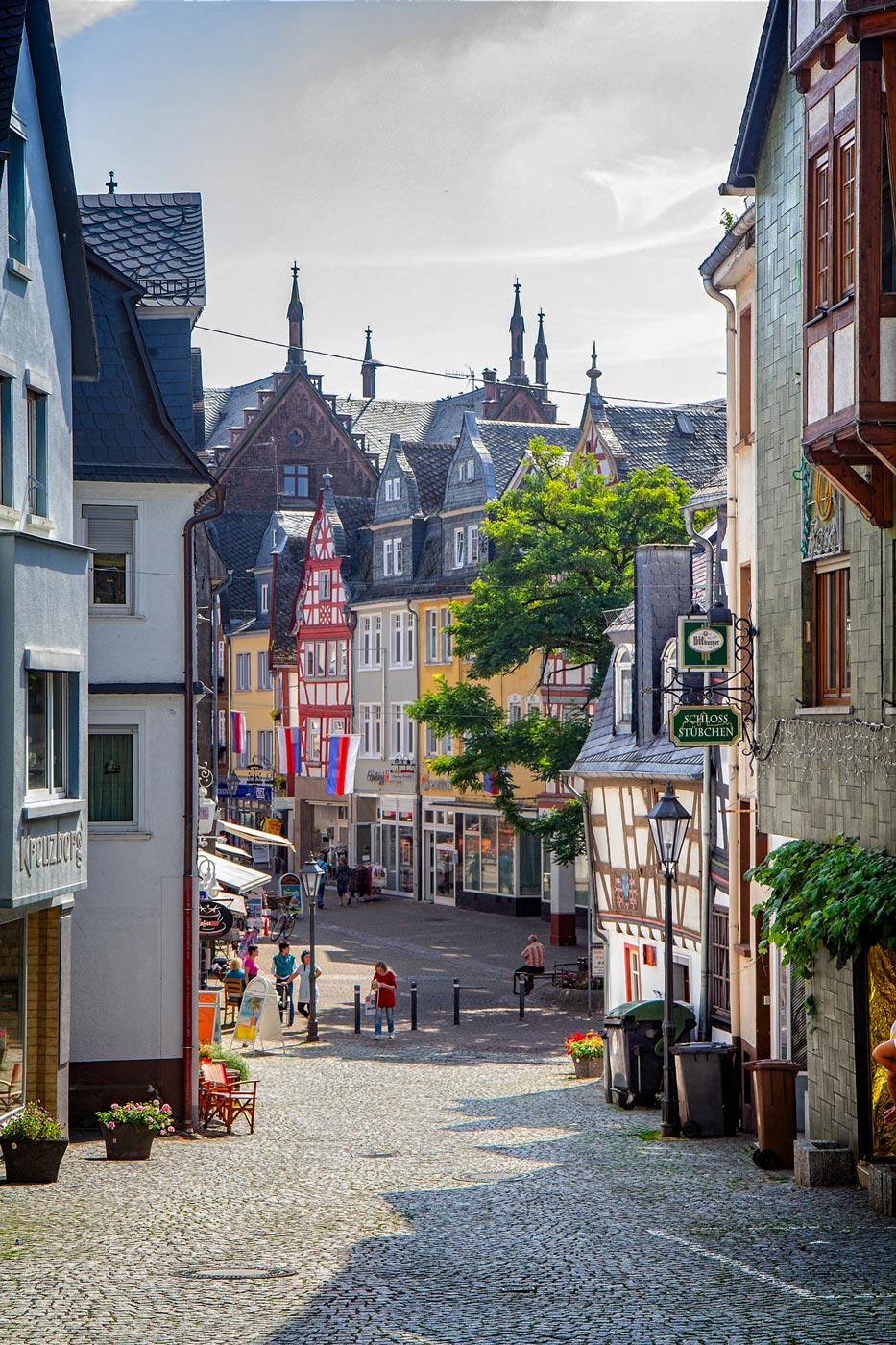
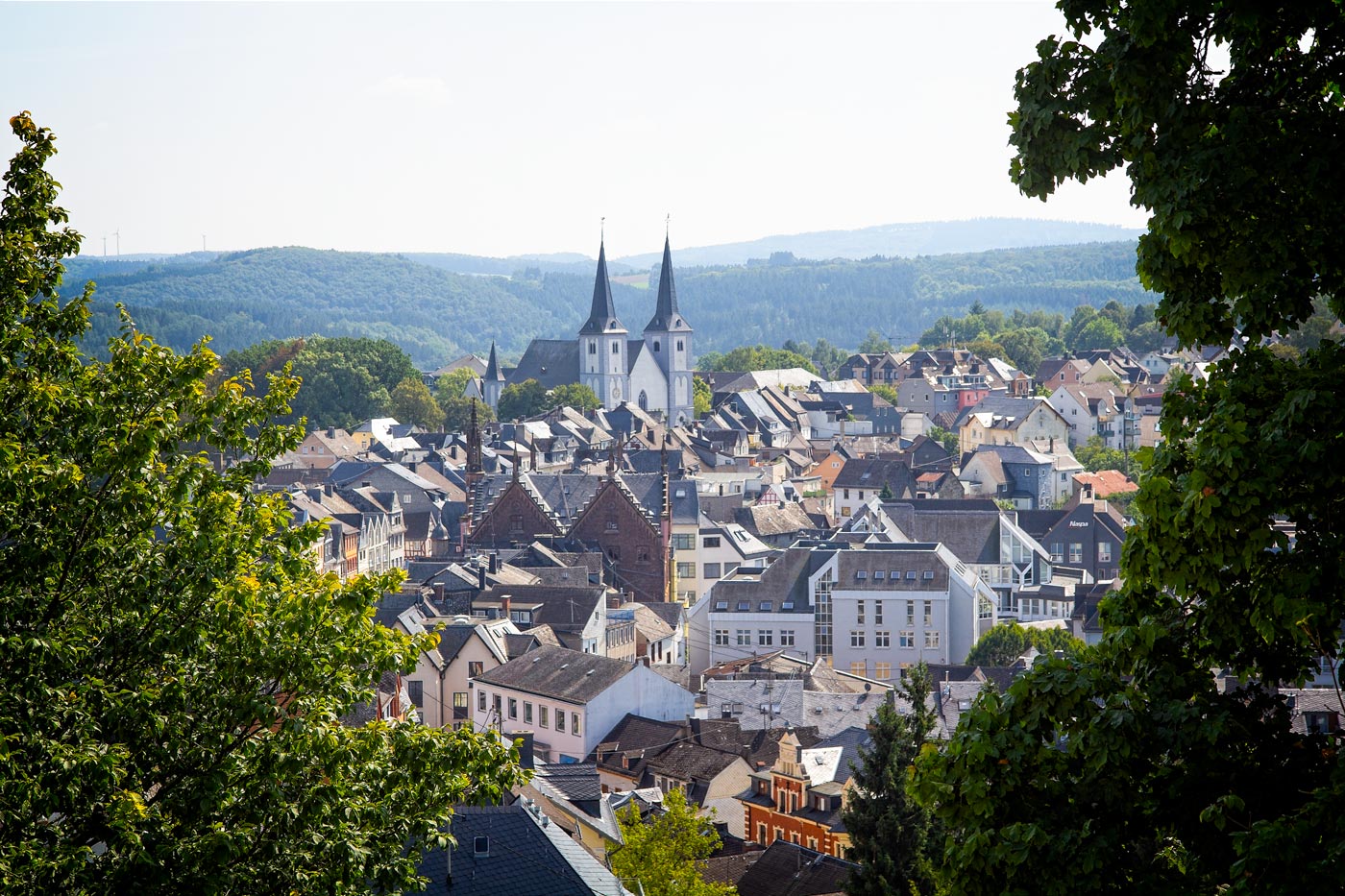
The view of Montabaur’s old town from the Schloss Montabaur.
We carried on down Highway 49 and not too far beyond Montabaur we came out on the Rhine River just south of Koblenz. We then turned South and started up river on Highway 42. The road was a secondary two lane highway that ran right along the river. There were little communities along the way, souvenir shops, small bars and restaurants. It was a totally enjoyable drive.
Along the way we saw old castles on the hillsides above the road way. Some were obviously in ruins but some showed signs of being still lived in. We stopped here and there as we travelled to take pictures, look at scenery and to take pictures. And that led us to a mistake. We were having such an enjoyable drive that we lost track of the time and as the sun set and it grew dark we had not found a place to stay for the night.
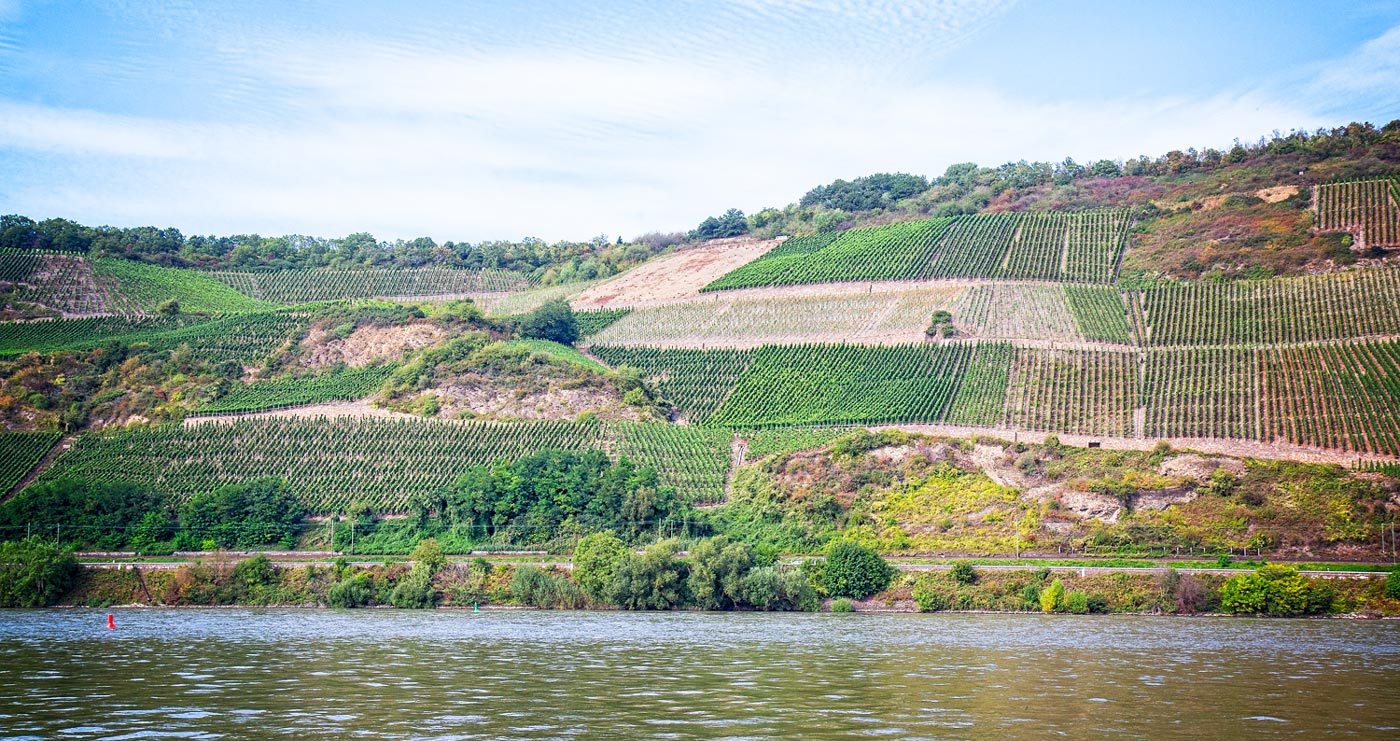
Looking across the Rhine you can see Highway 9 running along side the water with grape vinyards on the hillside above.
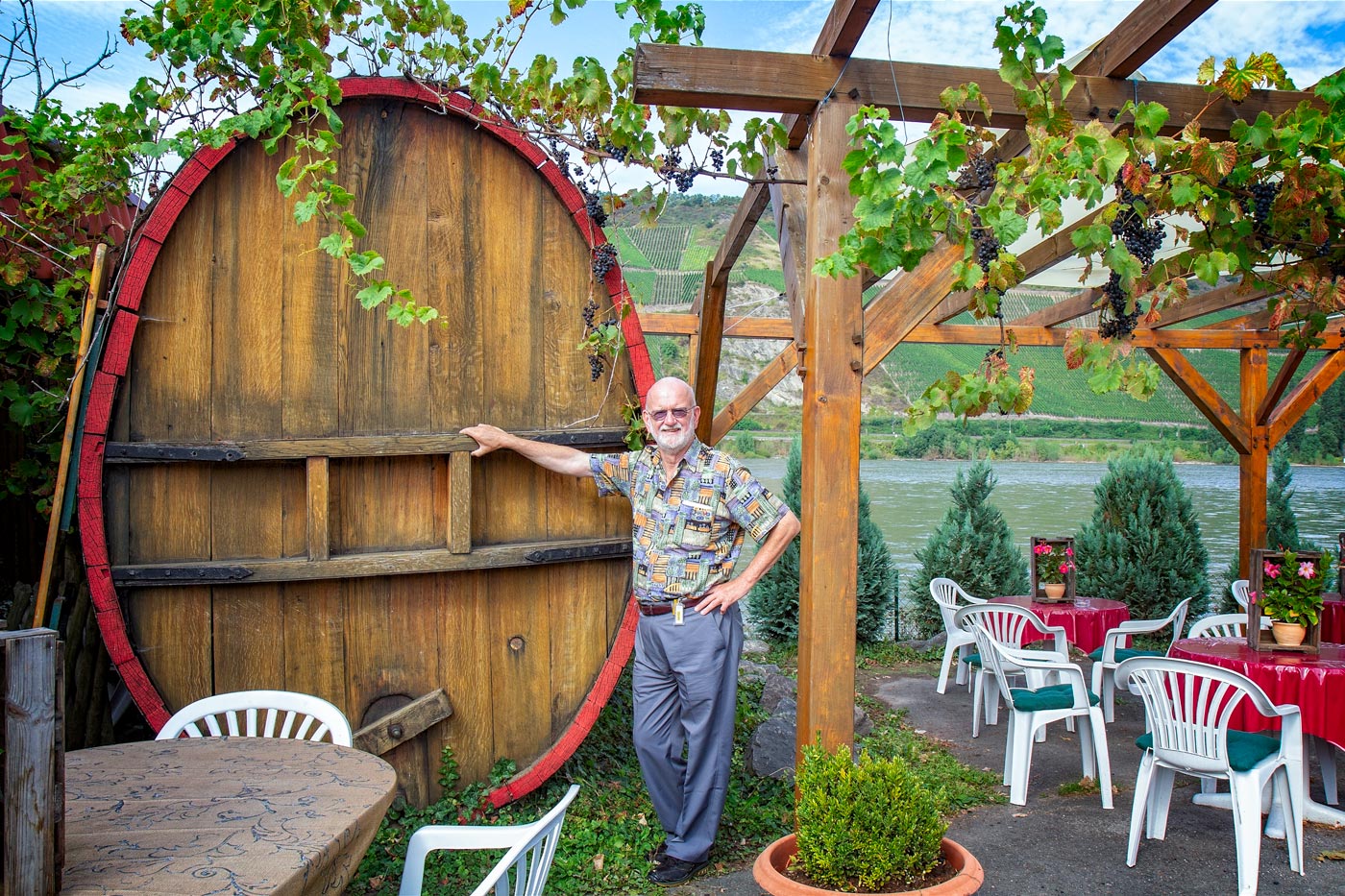
We stopped at a small restaurant on the river for a break. The Rhine is visible through the pergola over the restaurant tables and chairs.
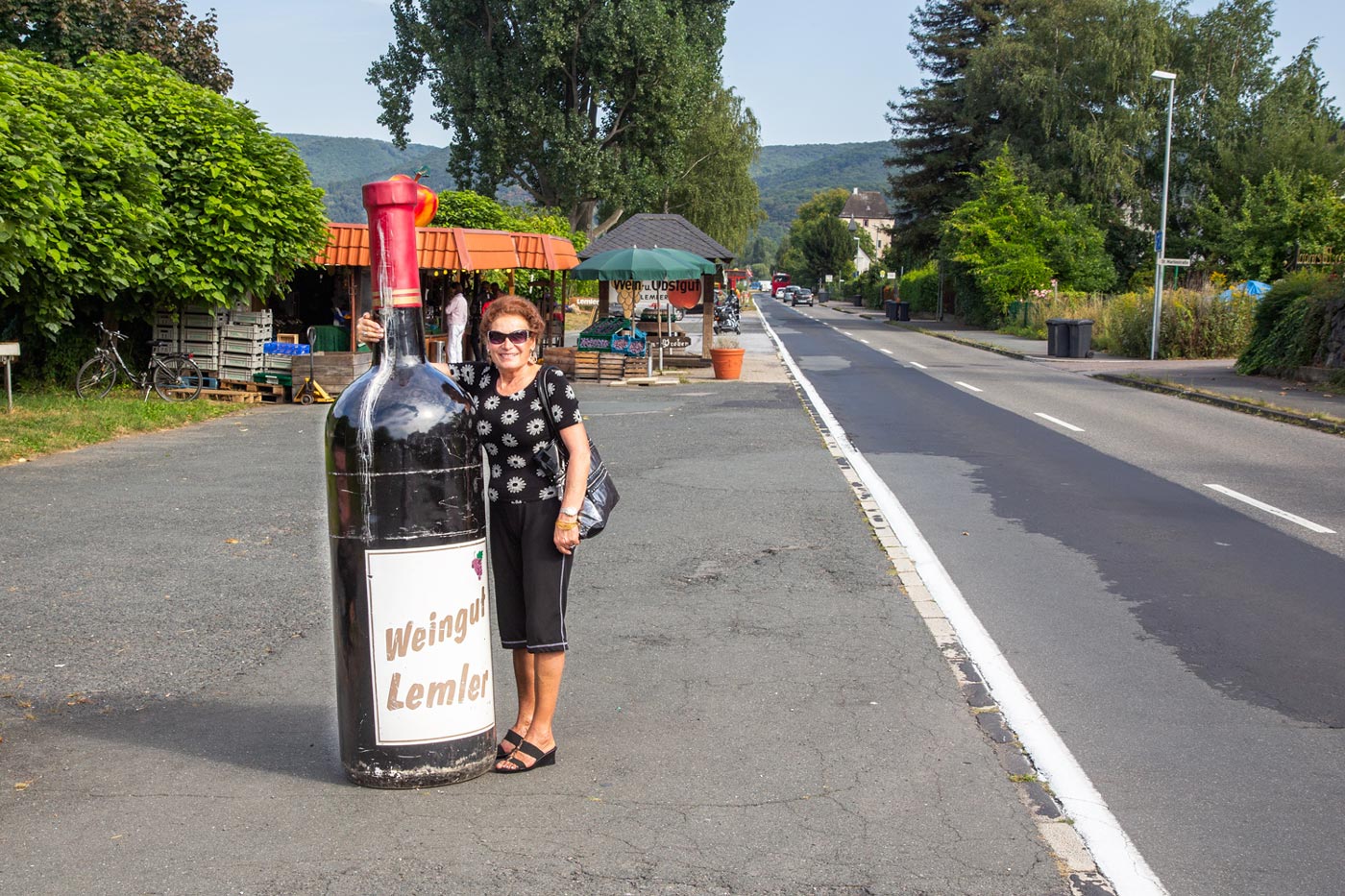
At one point we stopped for a glass of local wine. Highway 42 which you can see in this picture was a secondary two lane road, ideal for slow driving and sight seeing.
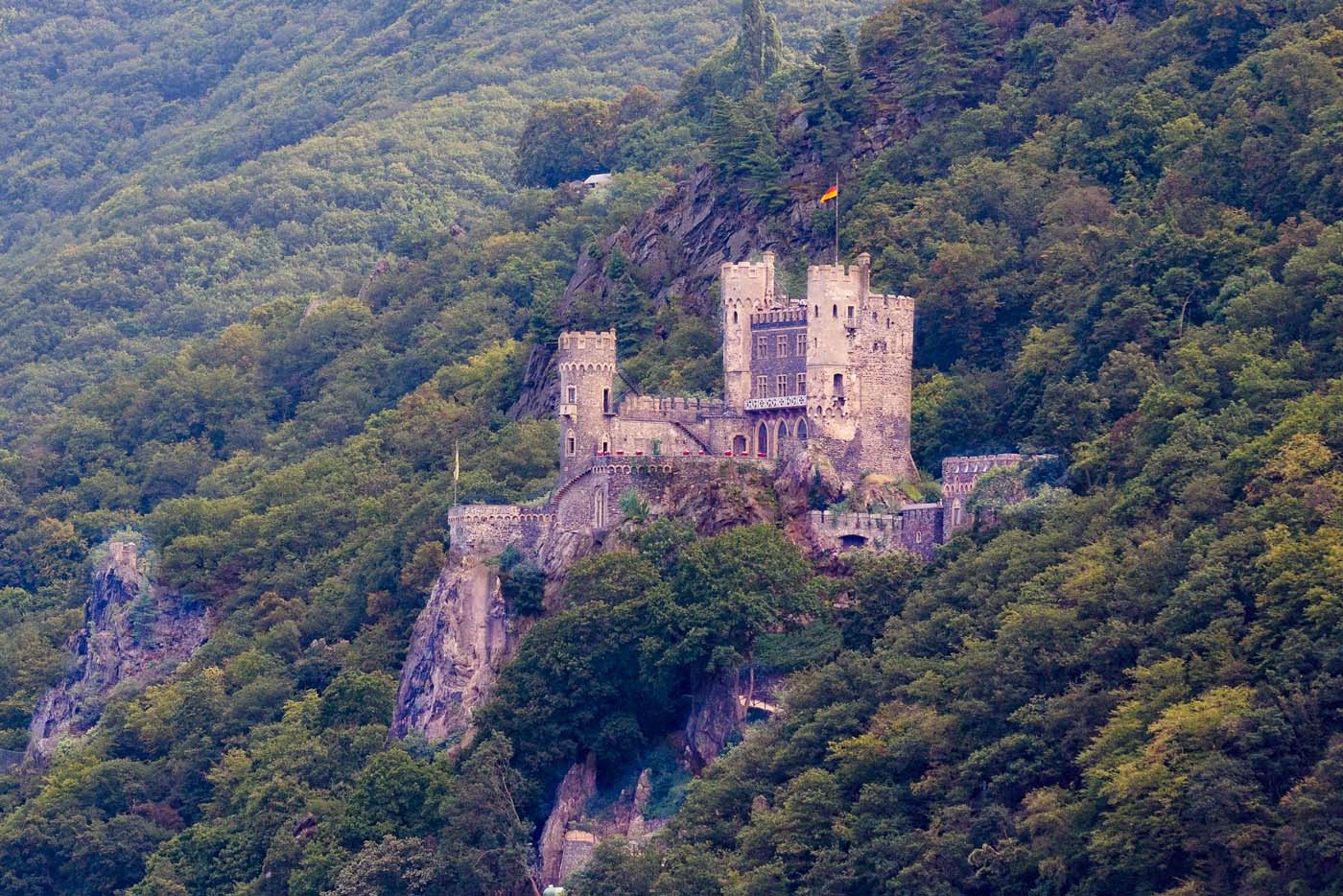
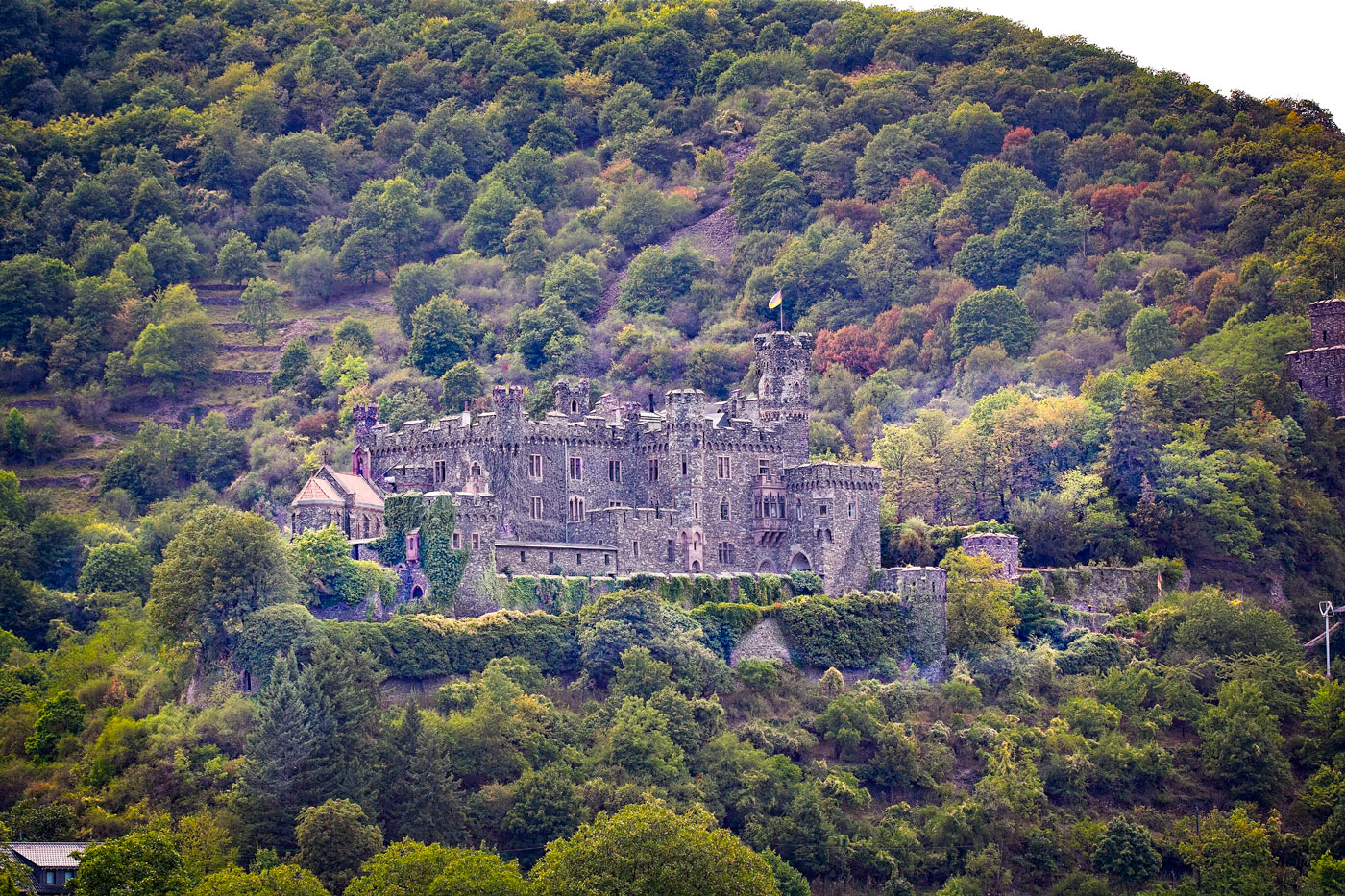
Many of the castles we saw along the river were obviously ruins but some were well kept and appeared to be lived in. Beautiful I am sure but they must cost a fortune to keep.
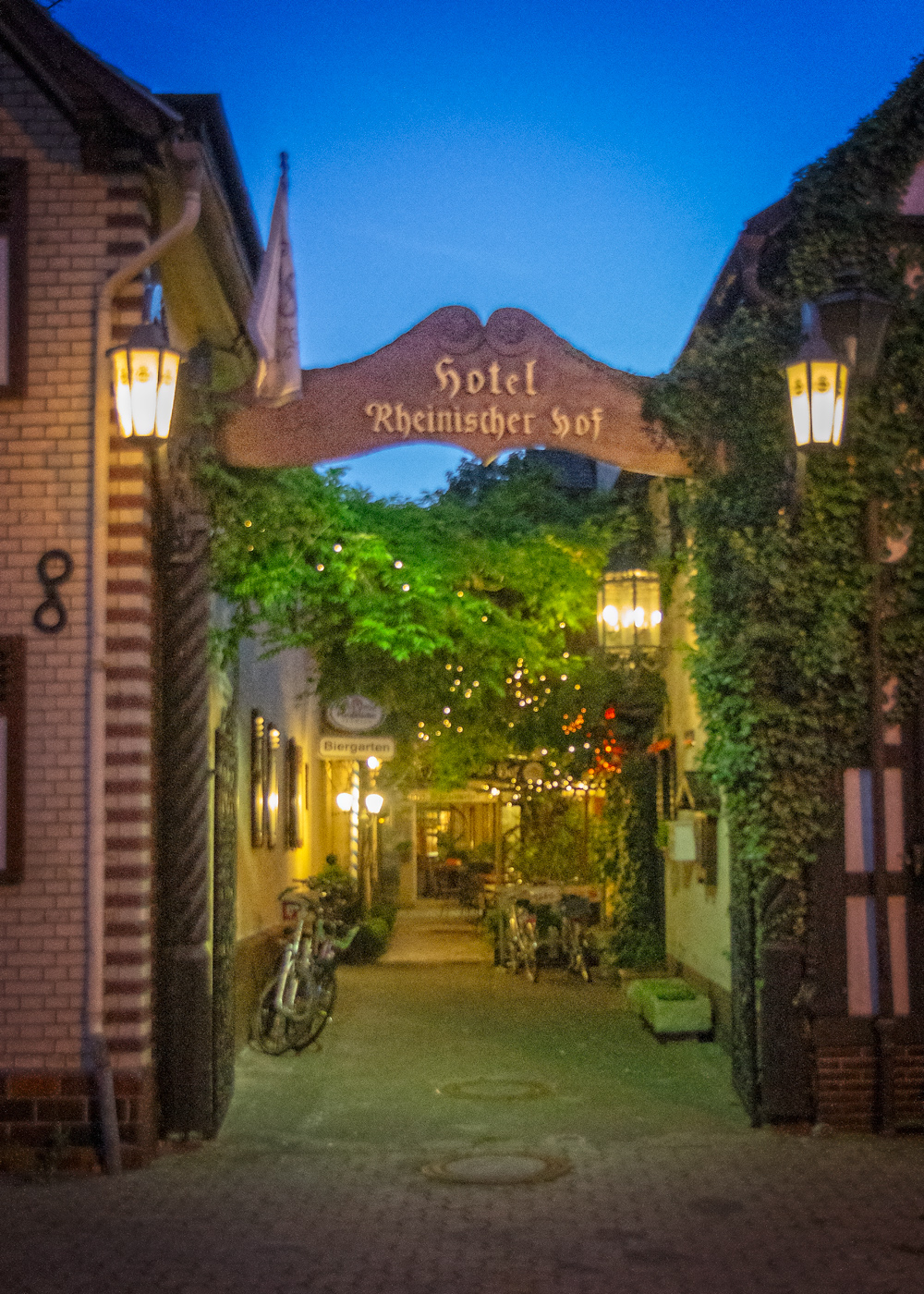
This is the rear entrance to the Rheinischer Hotel which we found after dark. This turned out to be a wonderful little hotel.
By 10pm it was dark and we were lost. It was beginning to look like we were going to sleep in the car. We blundered into a small town but the streets were dark and deserted. Just as we were about to give up our search we drove past a doorway that appeared to be an entrance to the Hotel Rheinischer Hof. We stopped, parked the car and walked in.
What we had found was
a most charming and
delightful little hotel with
an excellent dining room.
What we did not know
until the next morning
was that the front of the
hotel was on the banks
of the Rhine River! It was
beautiful.
The building the hotel is
in was built as a hotel in
1813 and has been
operated by the same
family ever since. The
name has changed in the
years since we were there
to the Hotel Peter Schafer.
They had room for us and so we checked in, got settled, and went to the dining room for dinner. The evening turned out to be one of the highlights of our trip. The restaurant was tastefully decorated in traditional German style. The service was excellent and the food wonderful. We had two bottles of a local Rhine wine of which Susan certainly had her share. That is notable because she does not drink!
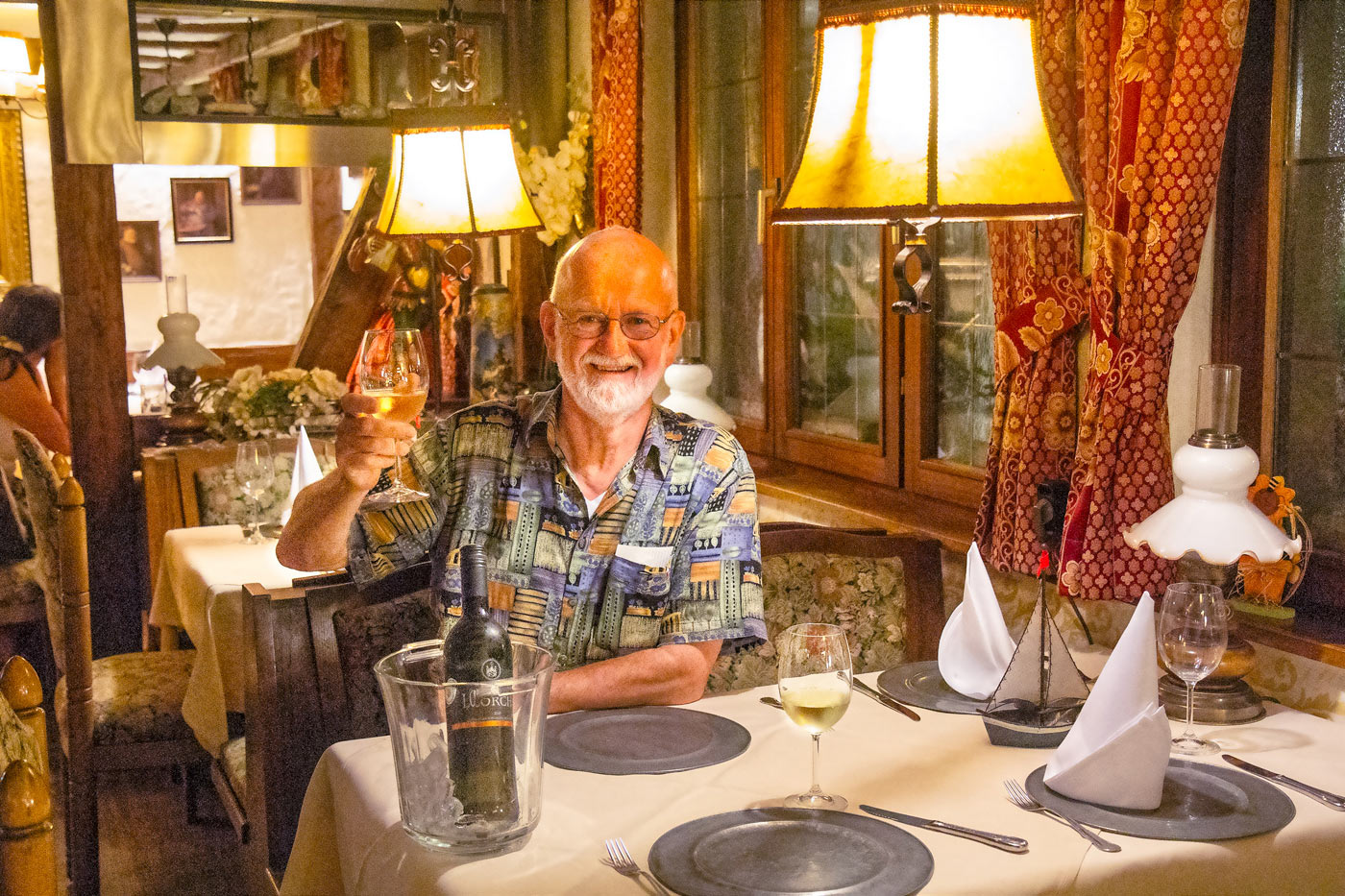
I don’t know my Rhine wines so I let the waitress chose one for us. It was incredible: Thomas Lorch 2010.
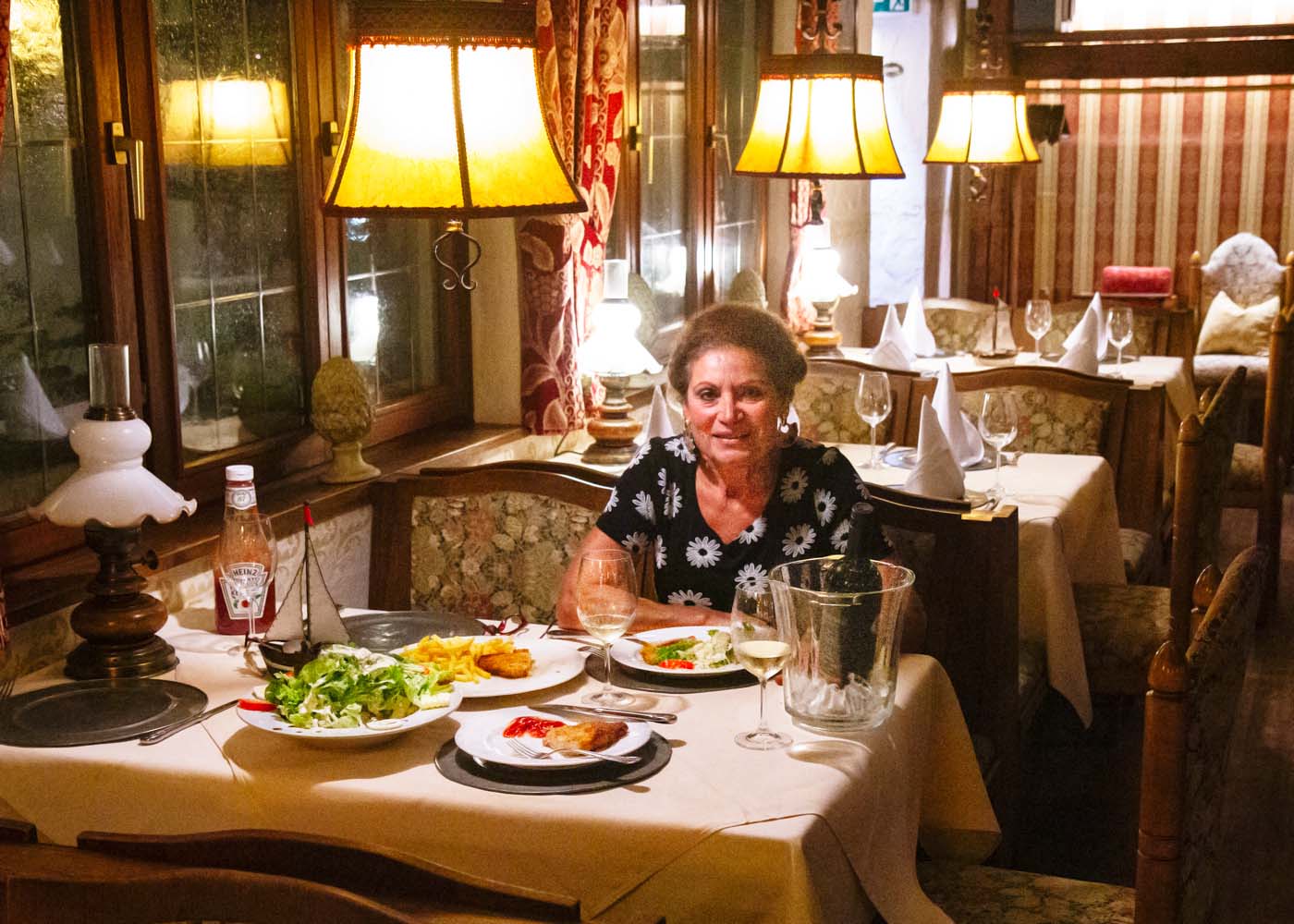
The dinner was excellent and to my surprise Susan enjoyed the wine. She enjoyed it so much that we went through two bottles.
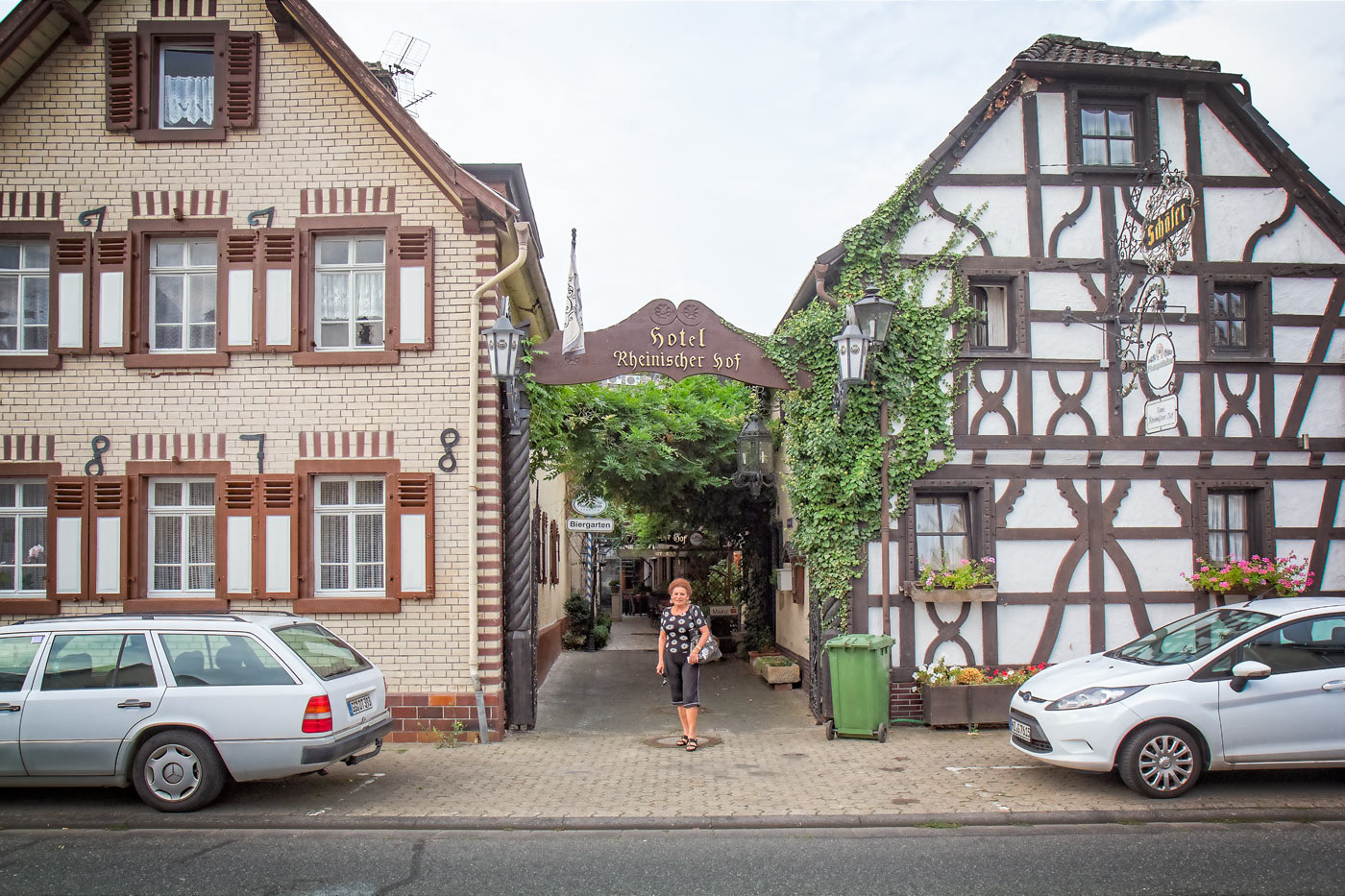
This is the rear entrance to the Rheinischer Hotel which we found after dark. This turned out to be a wonderful little hotel.
The next morning we awoke to a bright sunny day and we relaxed with a good breakfast and a walk in Ginsheim. We figured out that this was the town we ended up in last night after getting lost. And we discovered that we had come into the hotel by the back door and that in fact the hotel fronted on the Rhine River. It was an arm of the Rhine as there was an island in front of the hotel.
Once we had a chance to sit and get our maps out we quickly figured out where we were and where we wanted to go that day. We had to return our car in Zurich in a few days but first we wanted a quick drive in Switzerland. In particular I wanted to visit the little town of Grindewald which I had visited when I was in High School in 1960. I remembered it as being one of the most beautiful spots I had ever seen. So, today, it was off to the Swiss border.
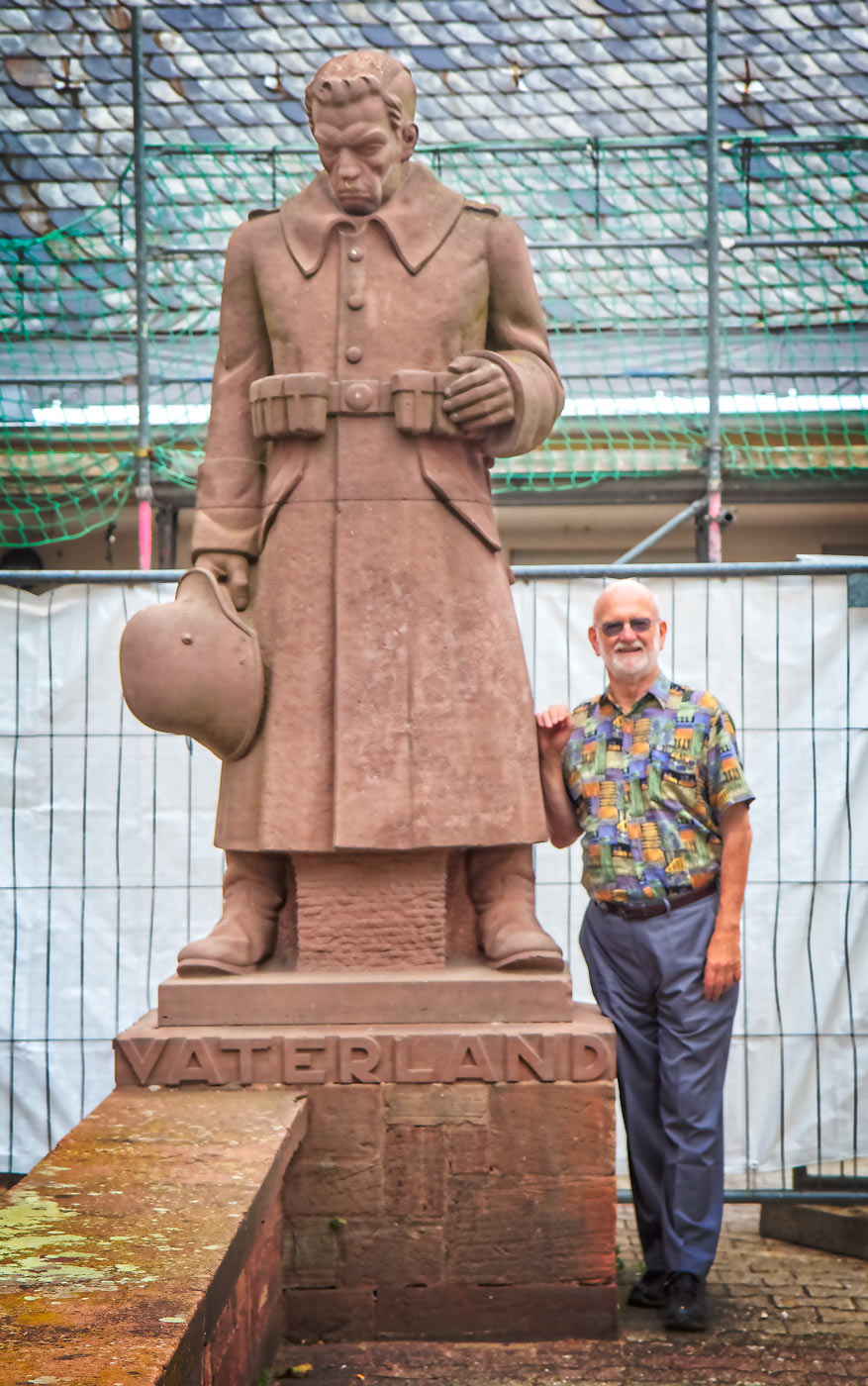
We found this beautiful statue to the “Fatherland” very near the hotel tucked away in a corner. I found it very touching and sensitive to the suffering of Germany in the 20th century.
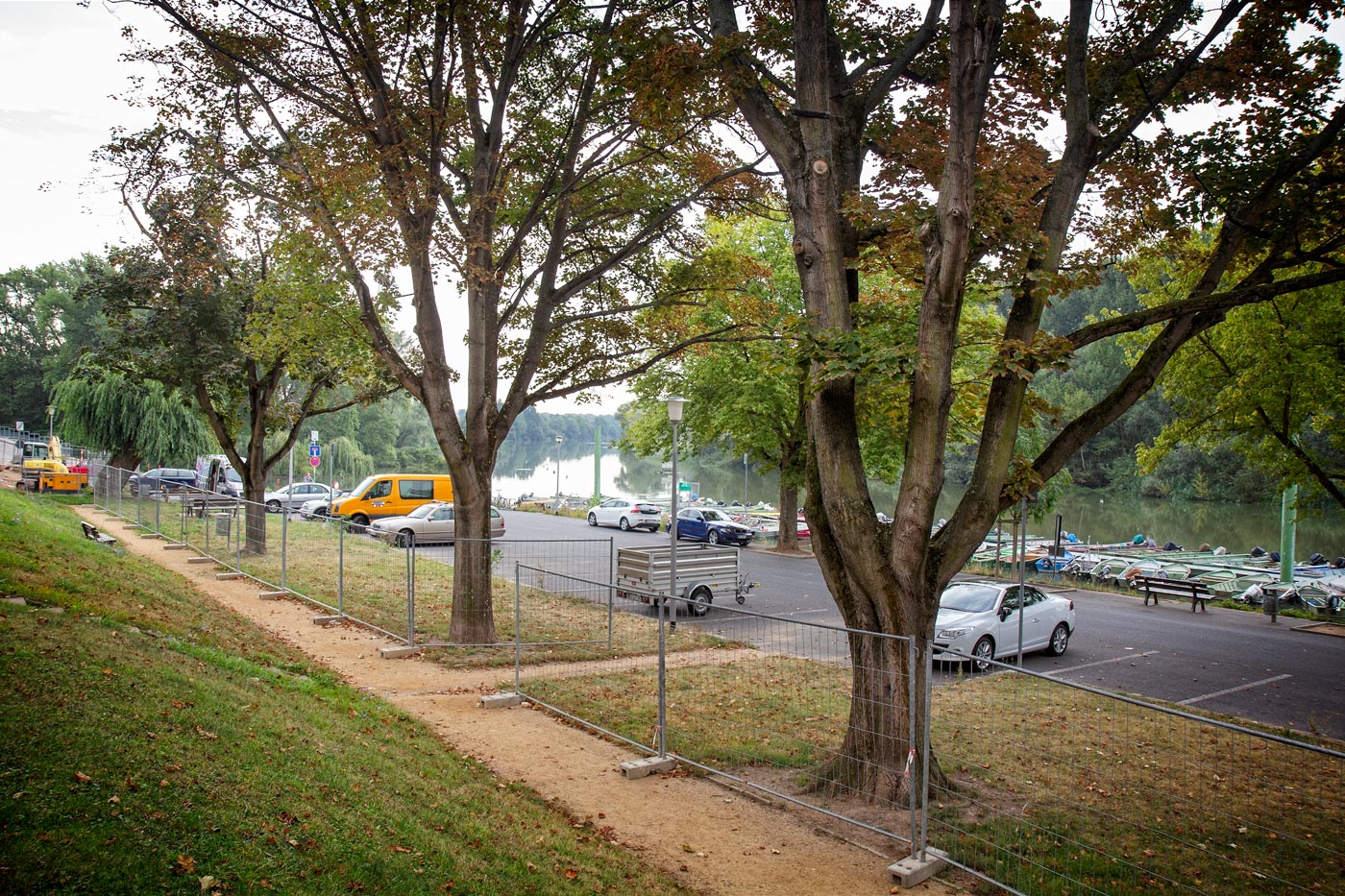
Standing at the entrance of the Rheinischer you can see the Rhine across the parking lot.
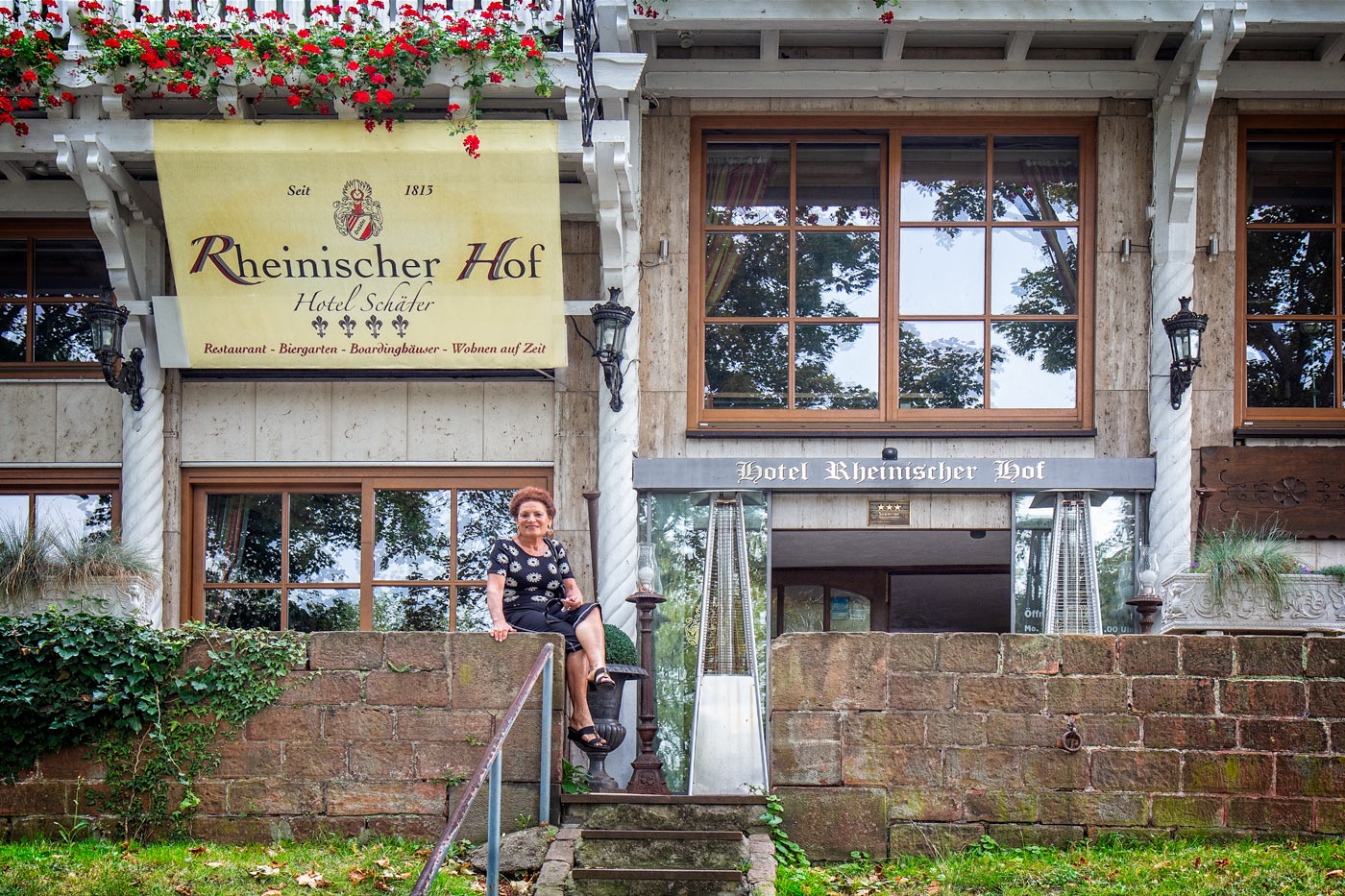
Susan is sitting on the deck of the front entrance to the Rheinischer Hotel.
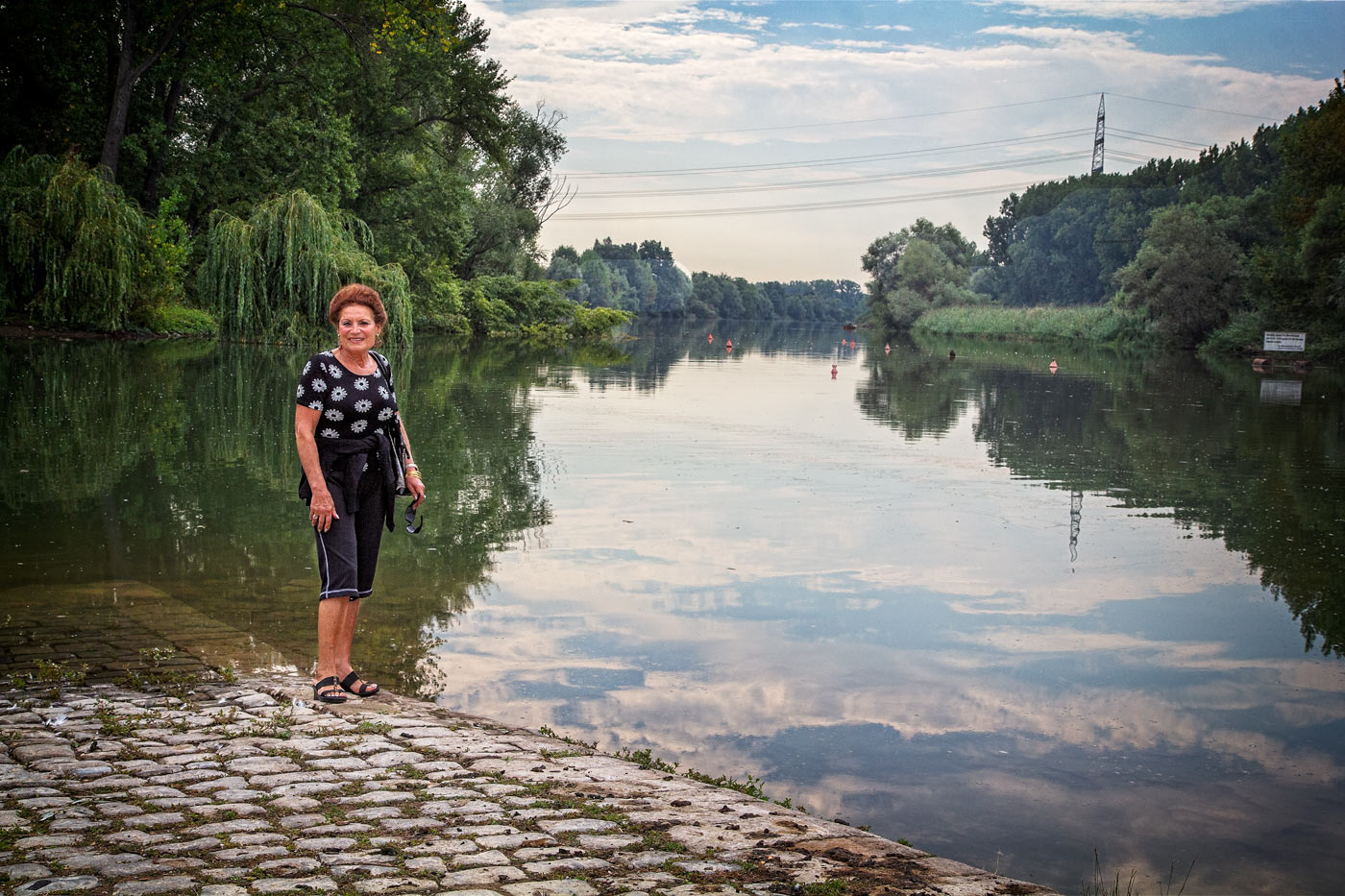
Susan on a boat launch ramp into the Rhine in front of the hotel.
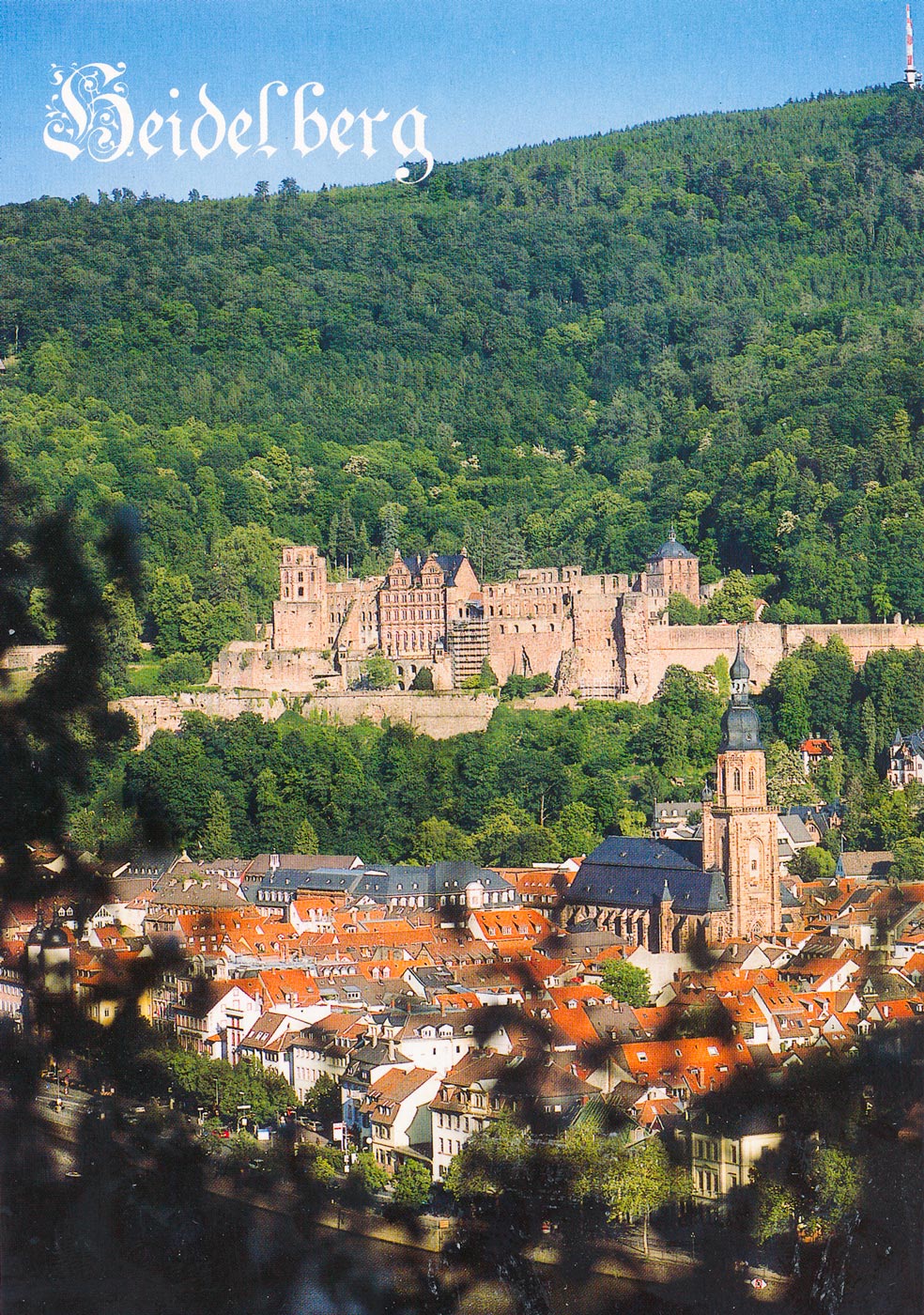
A post card I bought in Heidelberg showing the Schloss Heidelberg above the city.
After our morning walk around Ginsheim we packed up again and continued our drive south. I had traveled this route once before, in 1960 when I was a teenager cycling in Europe. On that trip we branched off at Mannheim and peddled up the Neckar River to Heidelberg. Since then I have come to love the music from the “Student Prince”, the one with Mario Lanza, and so on this trip I wanted to return to Heidelberg.
We drove into Heidelberg after lunch figuring we had two hours to visit the castle and look around before we carried on. The goal was to sleep in Switzerland that evening.
I remembered from my youth that the Schloss Heidelberg was built above the town with a view out over it. The post card on the left confirms my memory. So, once we drove into town I found a road that went up the bluff behind the town on the assumption that all roads would lead to the castle. Well, we can’t be right all the time.
We came out on top of the bluff you can see in the post card and, realizing my error, while I was looking for a place to turn around we came across the “Ehrenfriedhof Heidelberg”, the Heidelberg Cemetery of Honor.
The cemetery is really a Memorial Garden to the dead of two world wars set in the middle of a forest. It is a quiet contemplative place that exudes memory and peace. Stairs at the entrance lead to a long forested avenue which takes you into the cemetery itself. Large stone blocks bear the names of the Fallen and individual stone crosses mark the place where actual soldiers are buried.
We spent more time there than we should have but we had to leave and find our way to the Heidelberg castle.
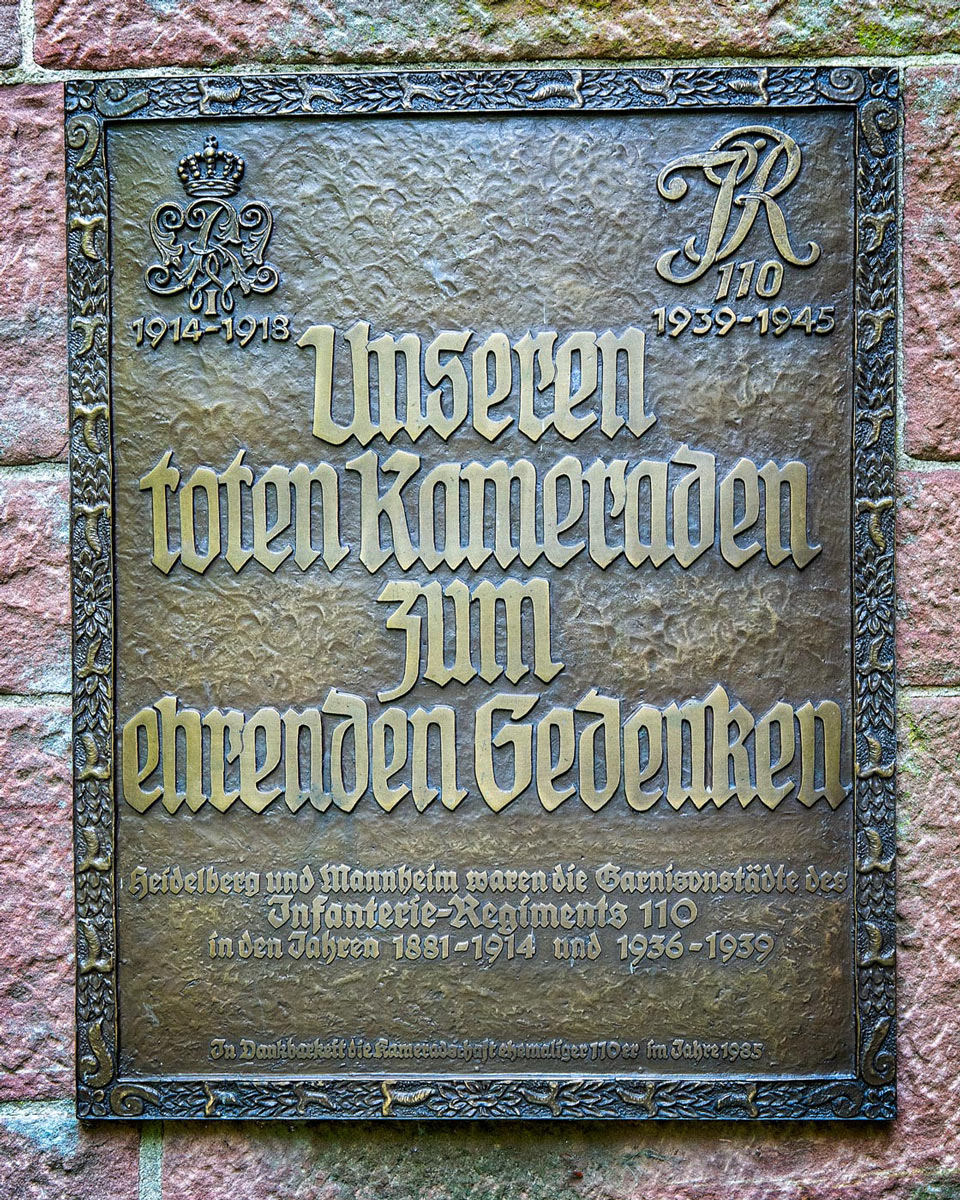
Plaque at the Entrance to the Cemetery: “In Honorable Memory of our Fallen Comrades”
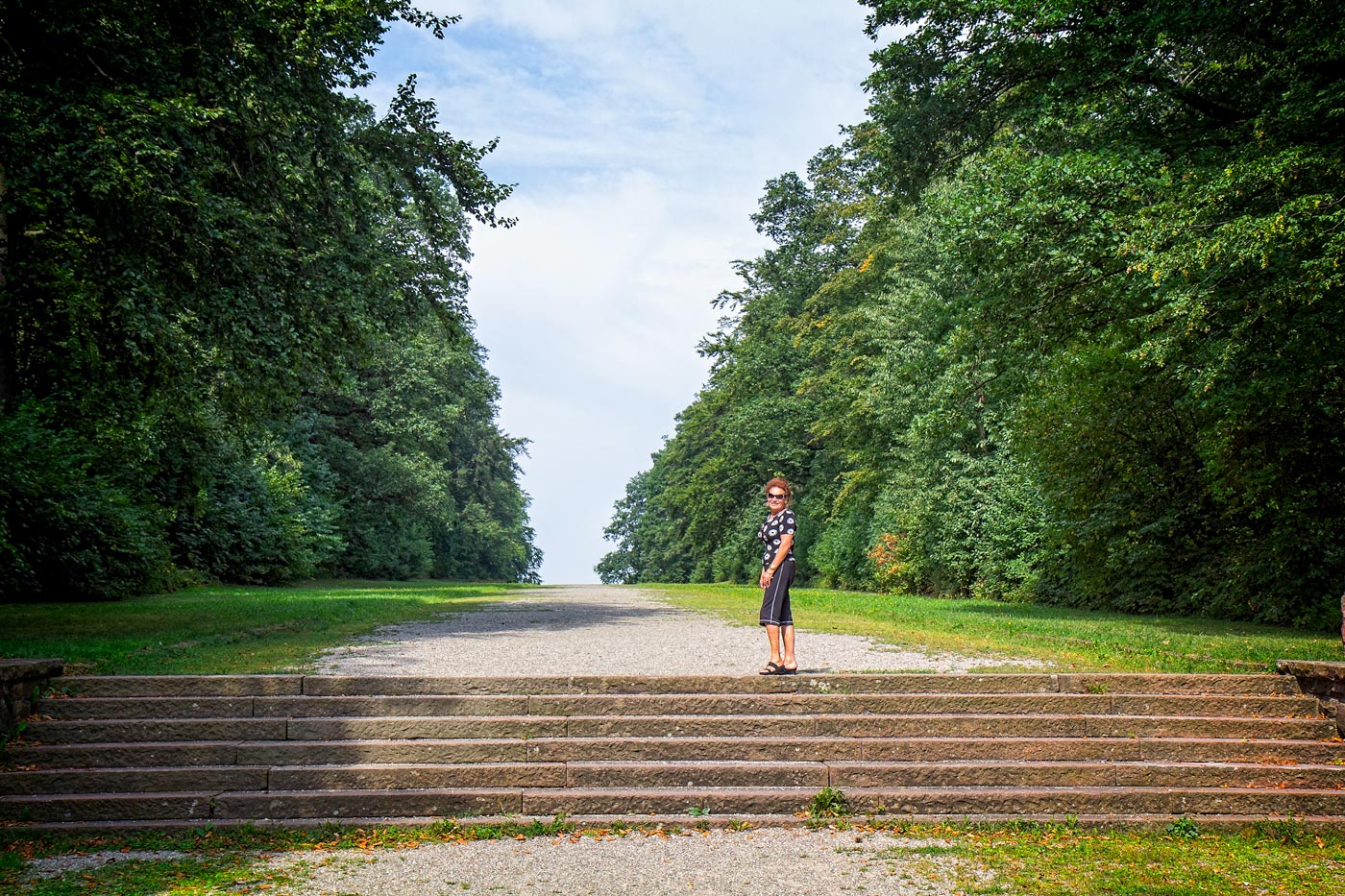
Susan at the entrance to the Ehrenfriedhof Heidelberg. It is a large memorial park and a beautiful monument to their fallen soldiers, young men who were just serving their country.
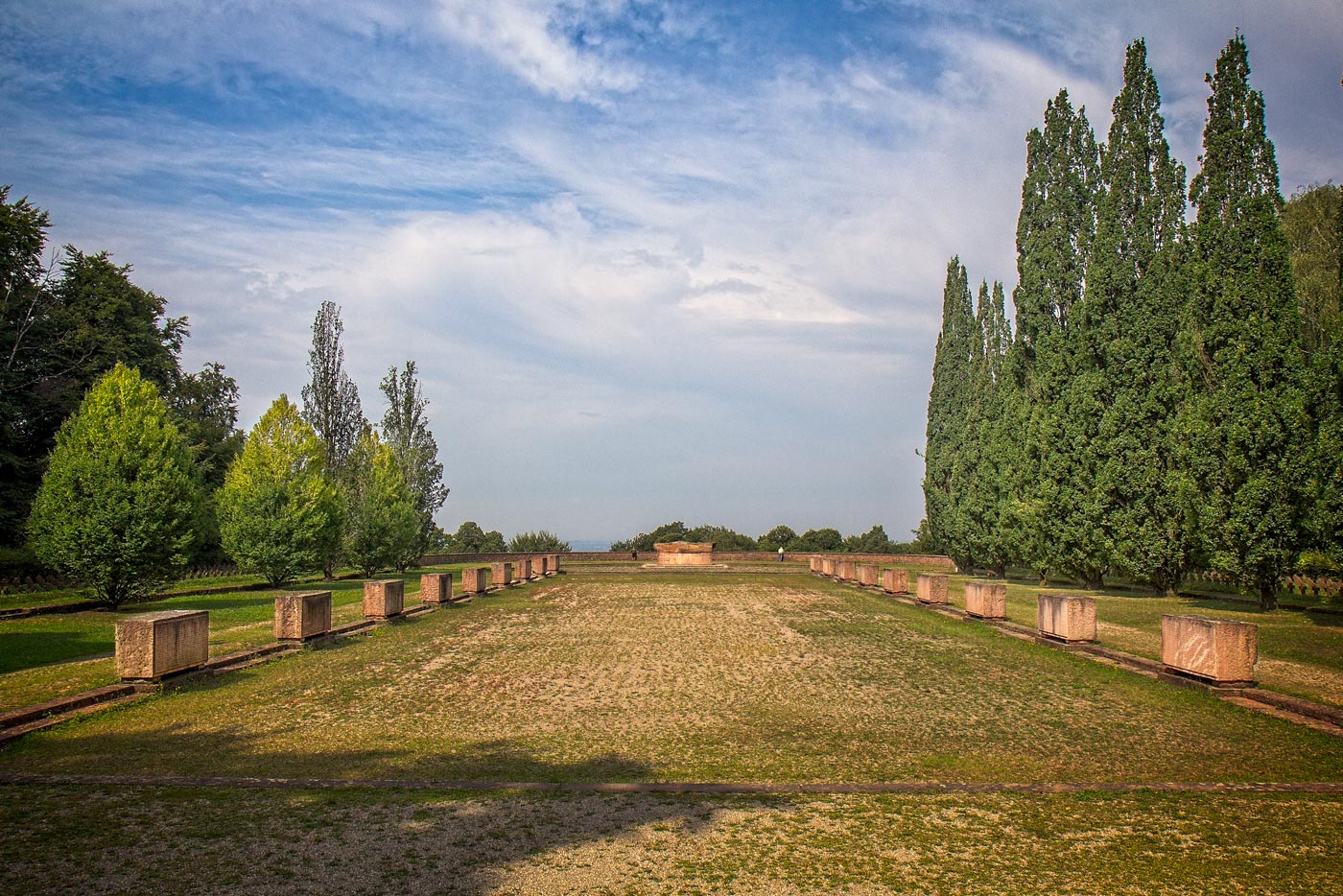
The center of the Memorial with stone blocks bearing the names of the dead.
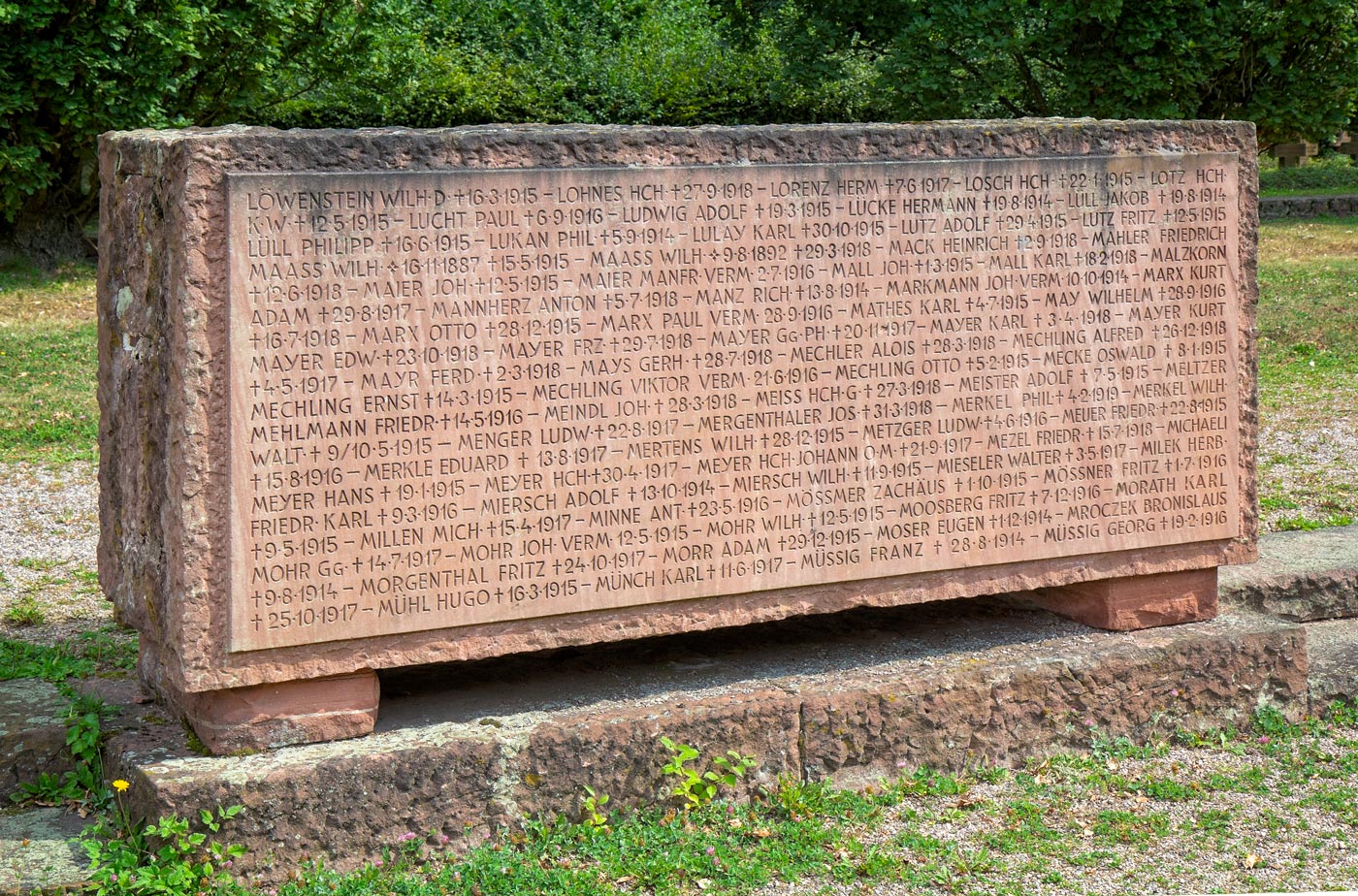
So many names from wars that are gone and almost forgotten.
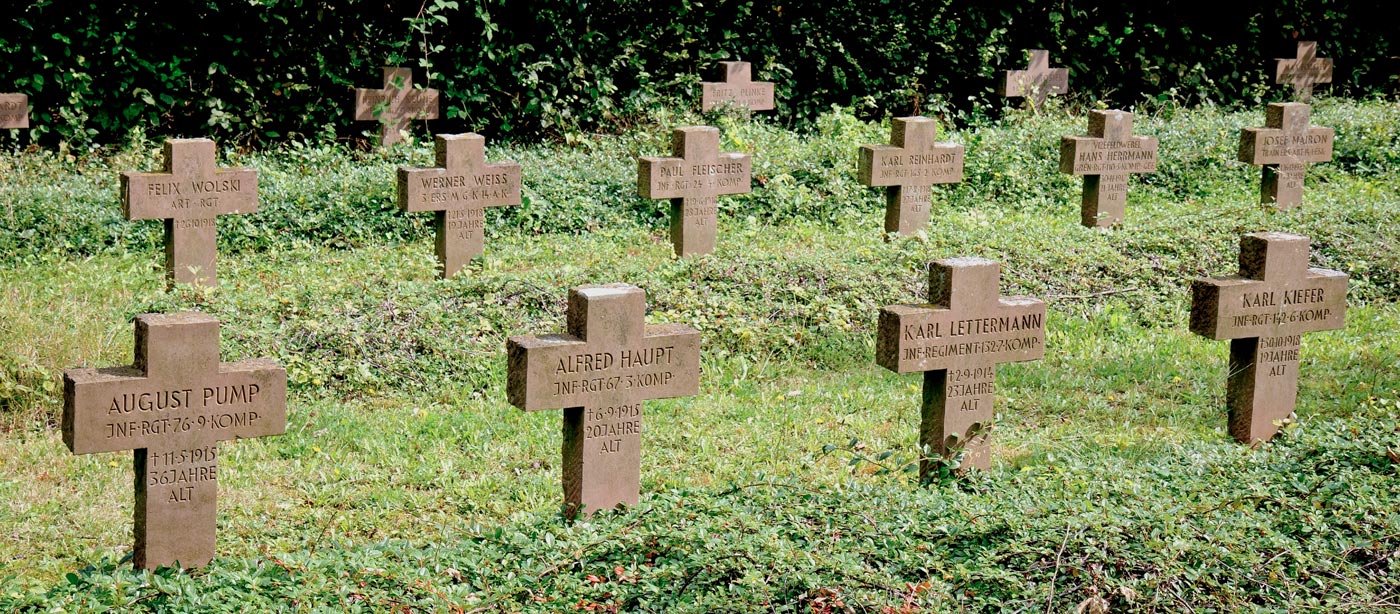
There are actually remains of over a thousand soldiers beneath the ground their places marked by a simple cross.
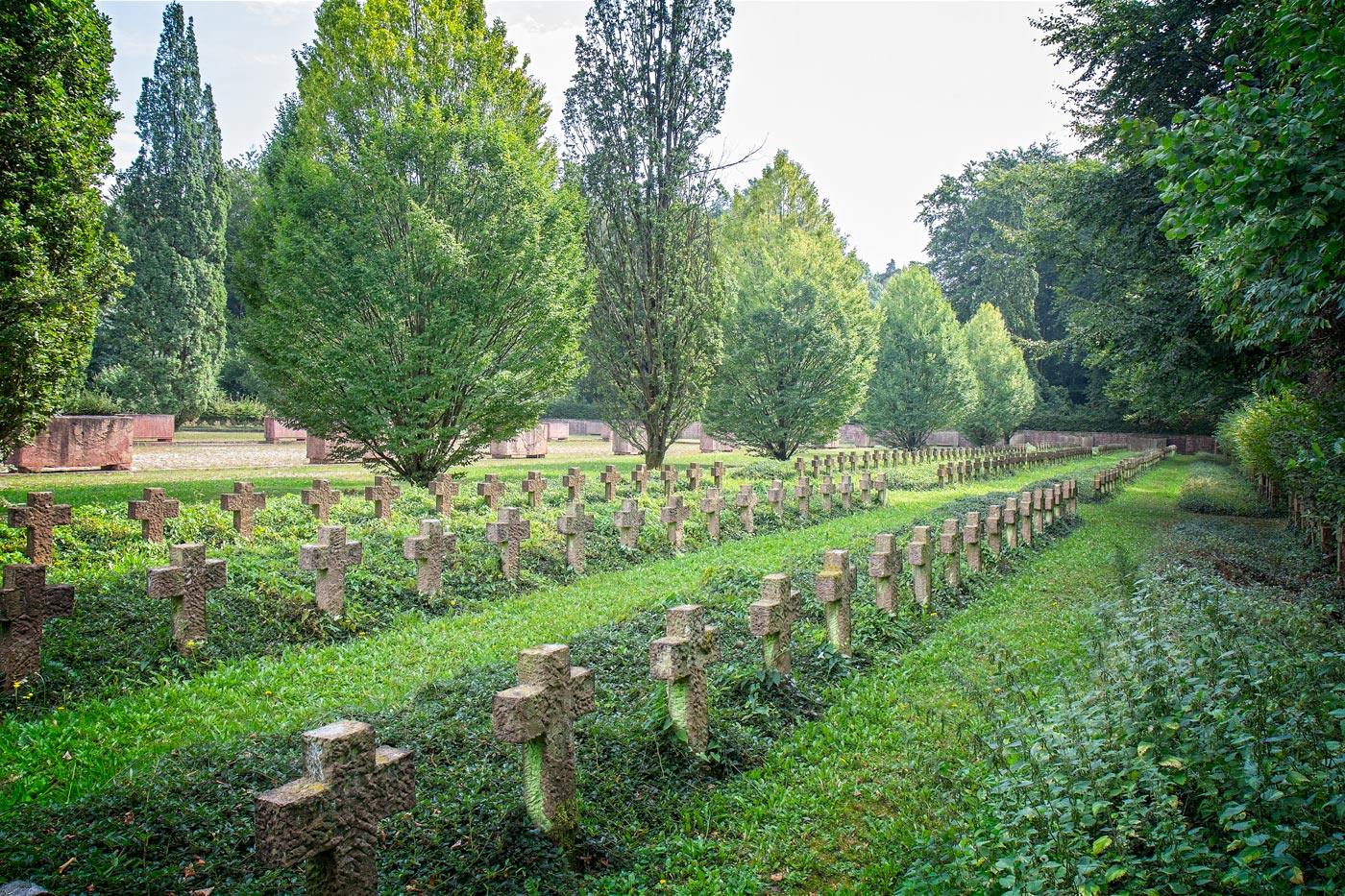
The tragedy of war is told by the rows of crosses. Such a waste!
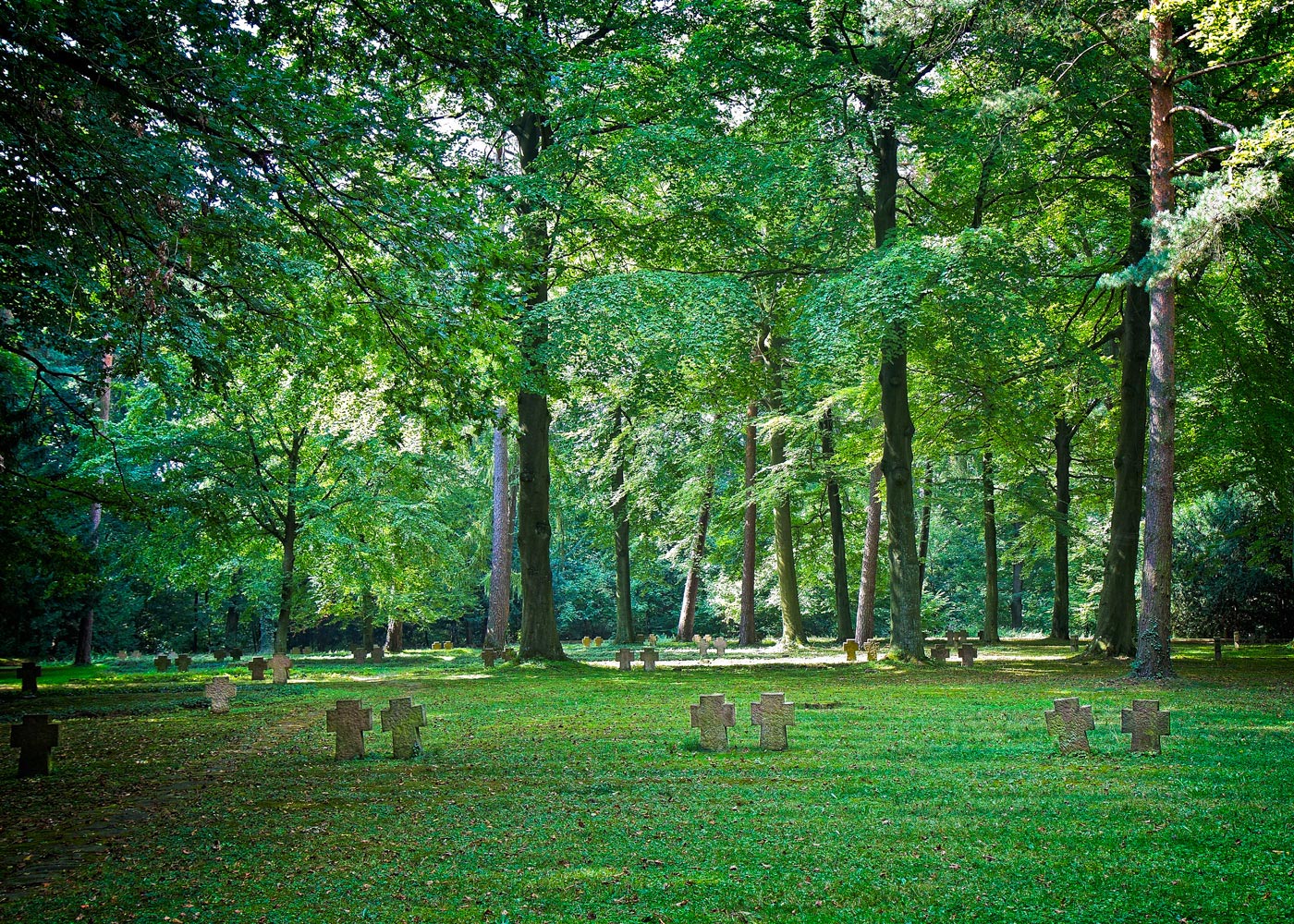
Some graves are spread out under the surrounding trees.
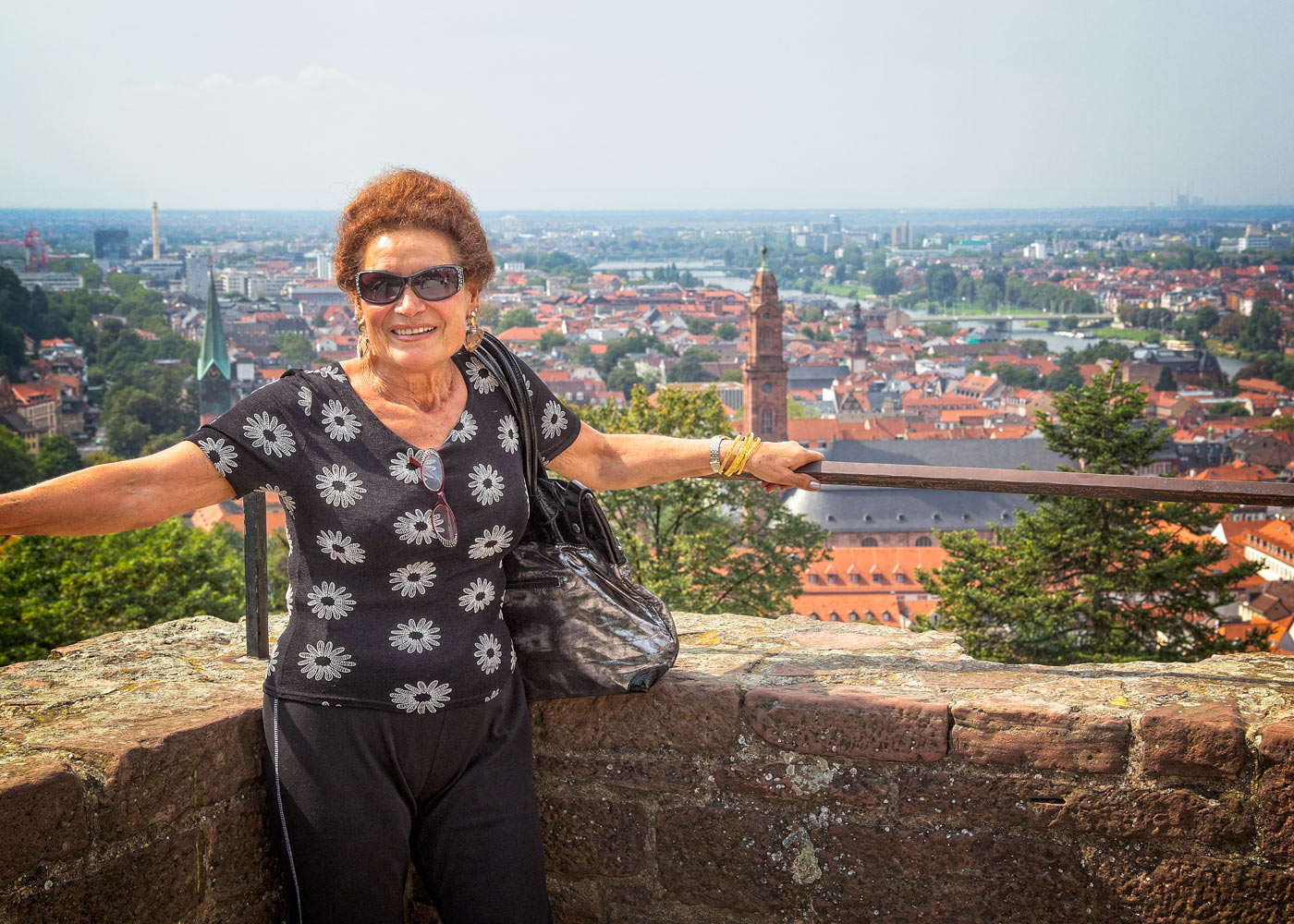
Susan at the view point looking over Heidelberg from the “Ehrenfriedhof Heidelberg”.
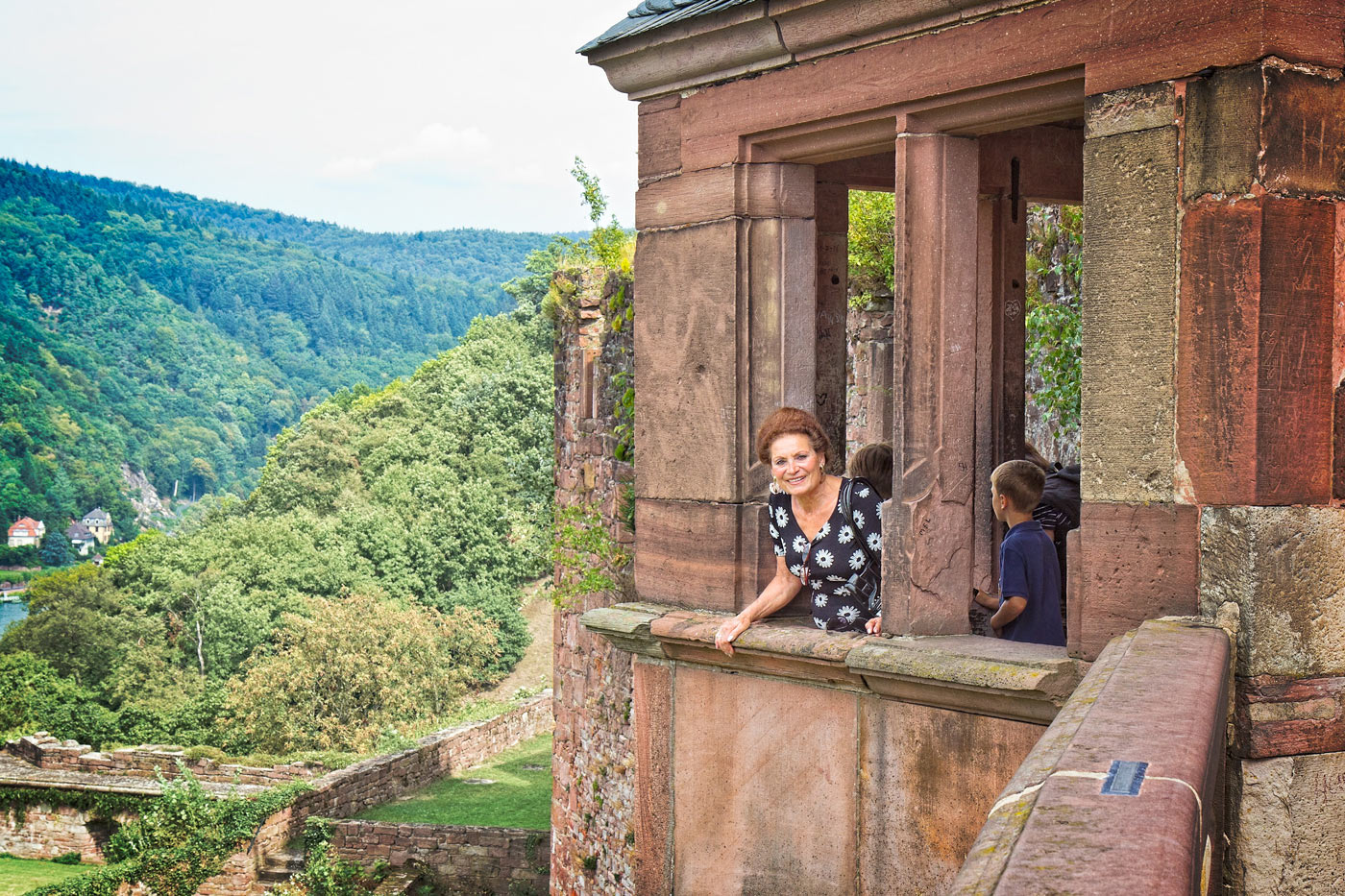
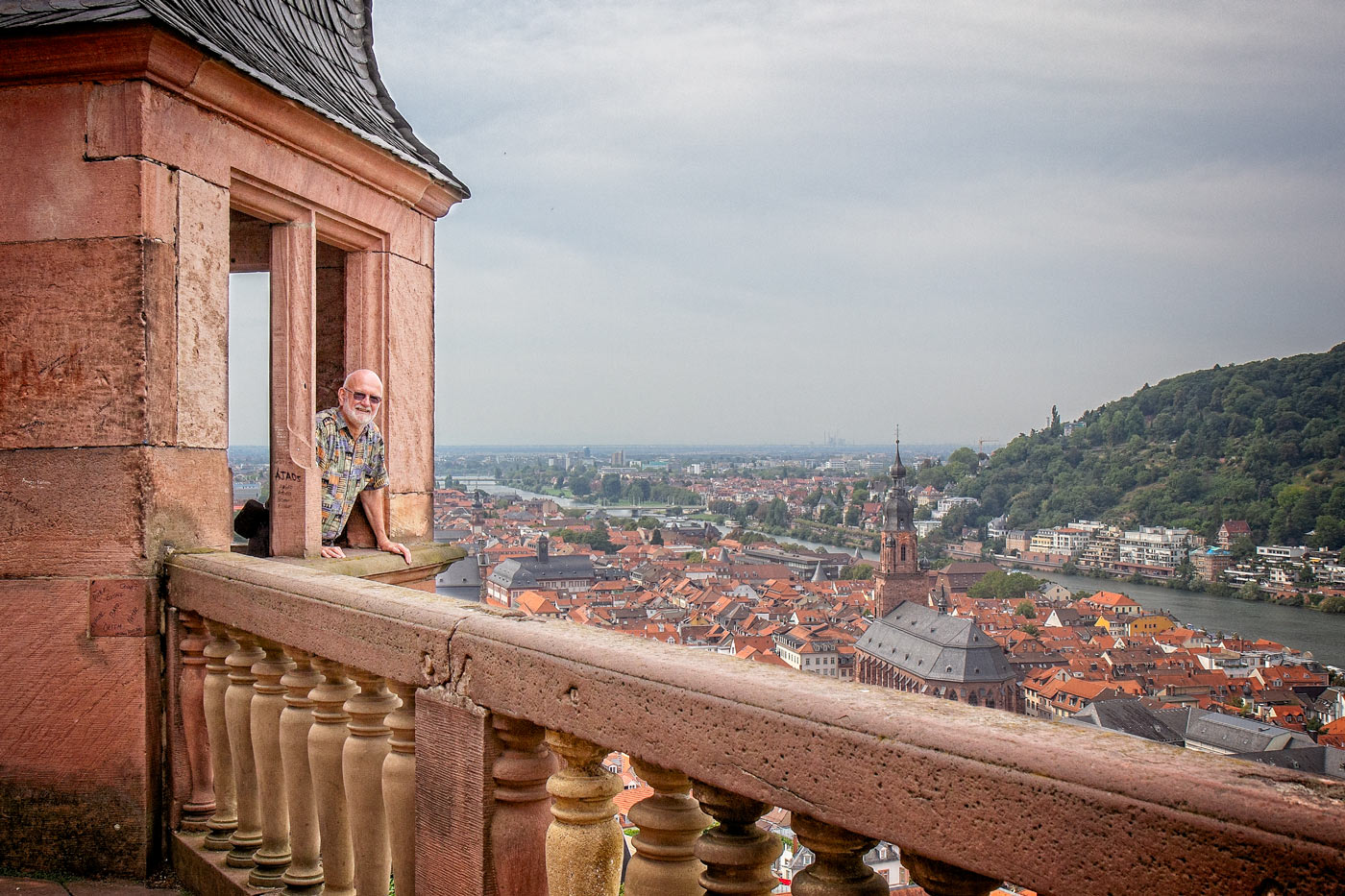
Susan looks out an old window in the piazza in front of the Schloss Heidelberg.
There has been a castle in Heidelberg since at least the 13th century. In fact there were two, one on the site of the current one and another further up the hill. The upper one was destroyed in the 1500’s and the lower one had a string of bad luck. It was damaged in war and struck by lightening several times.
In 1764 lightening began a fire that ravaged the castle leaving it an abandoned ruin. It did not help that the stone of the castle was quarried by the people of Heidelberg to build their homes which only accelerated the decay.
In the mid 1800’s consideration was given to rebuilding the castle. However it was determined to be too expensive. Some restoration was undertaken and completed in 1900. And since then it has sat as we found it that day.
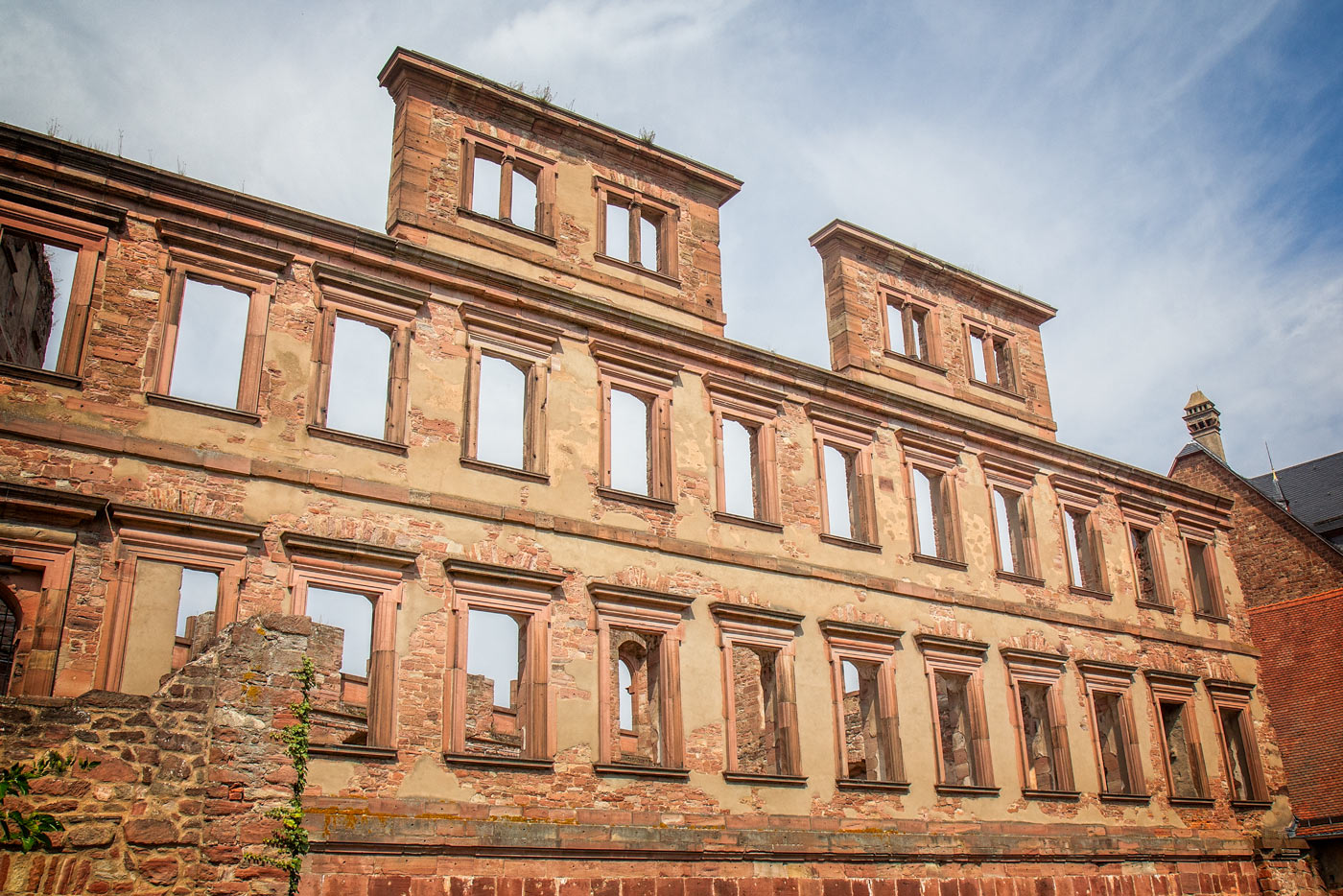
Much of Schloss Heidelberg is in ruin and obviously has been for many years.
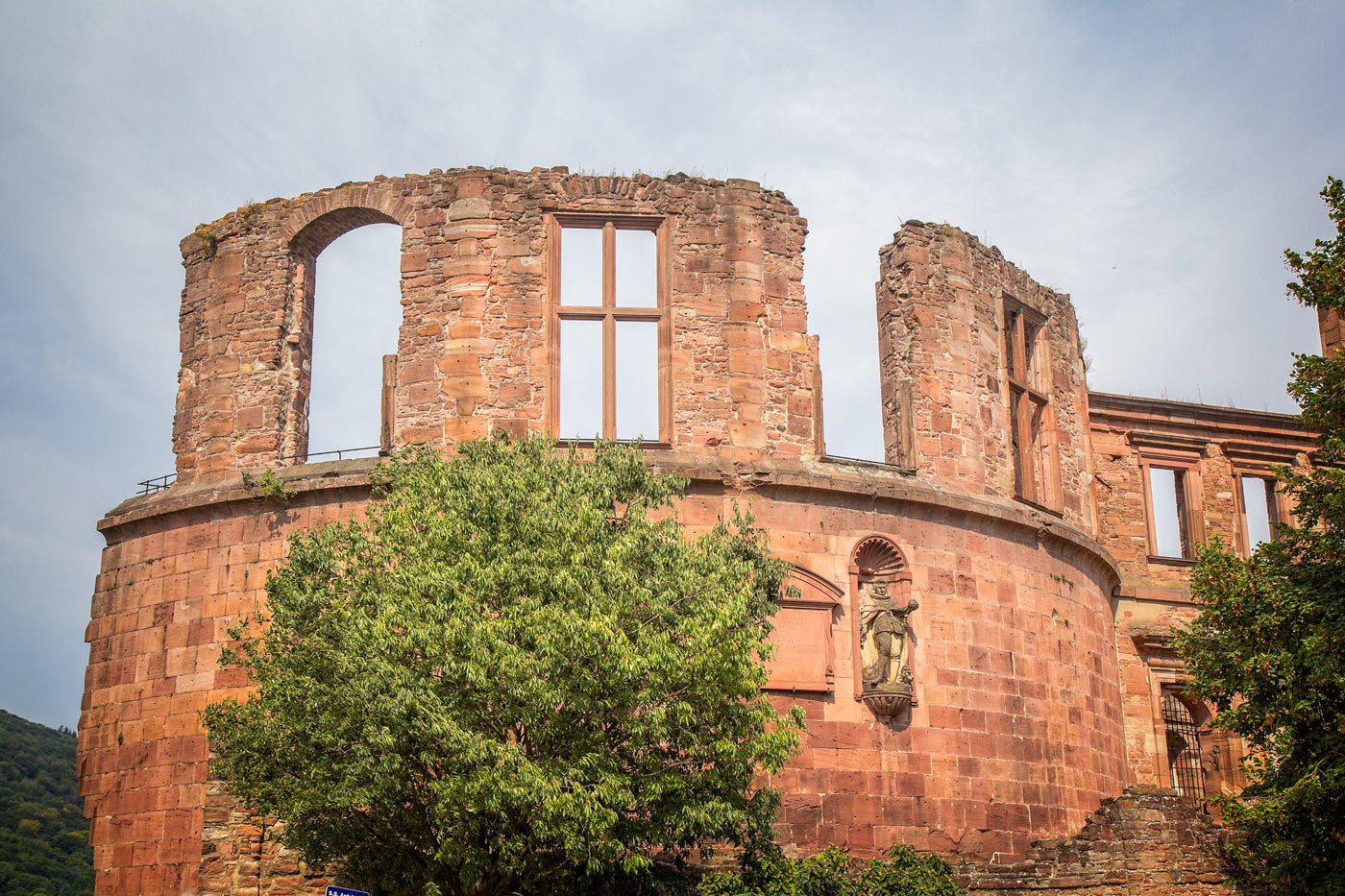
This castle has had a very unfortunate history yet it was once very impressive.
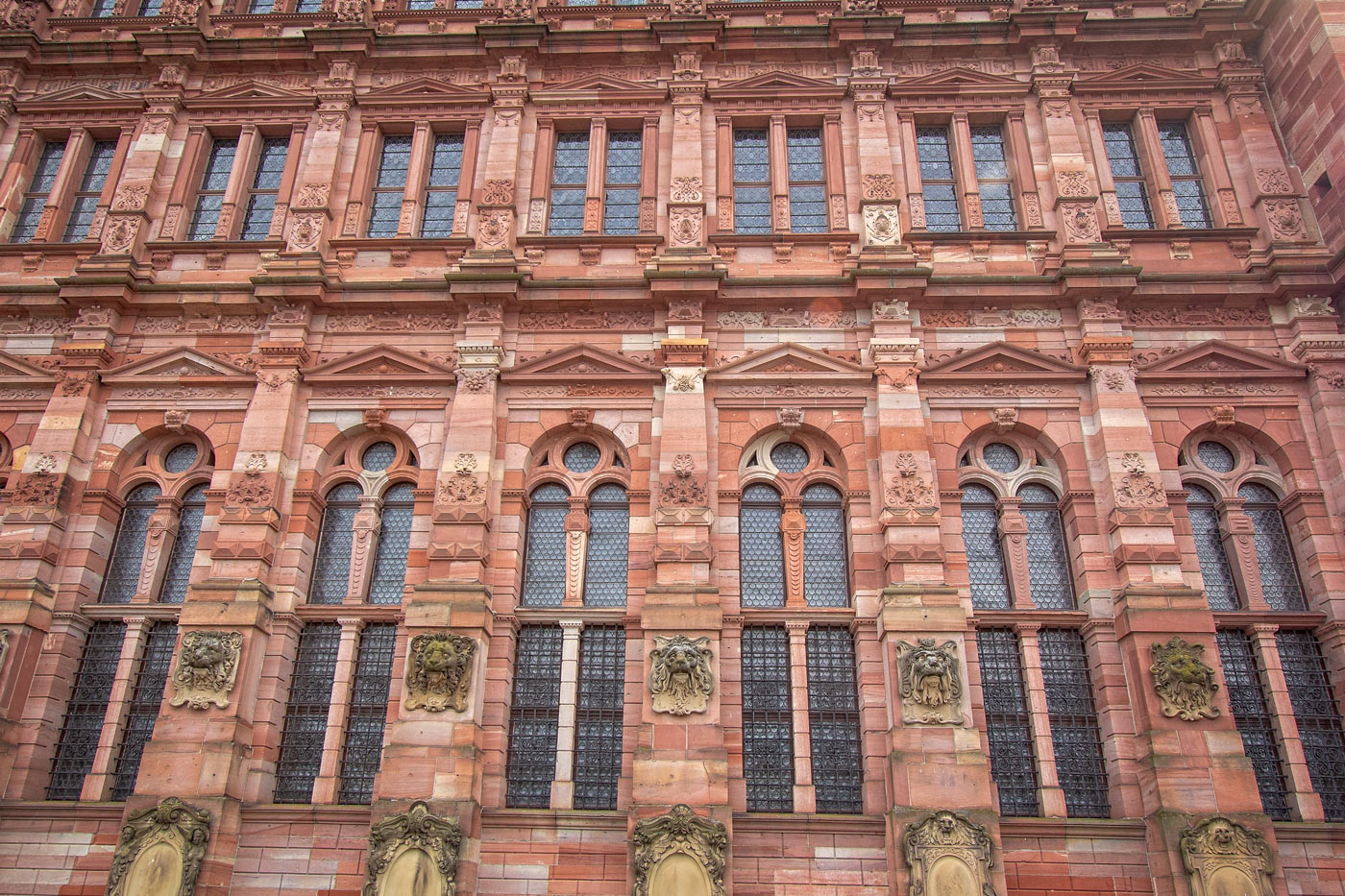
Some parts have been restored to their former glory the whole complex must have been glorious.
The Schloss Heidelberg has a large patio across the front of the castle looking out over the city of Heidelberg and the River Neckar.
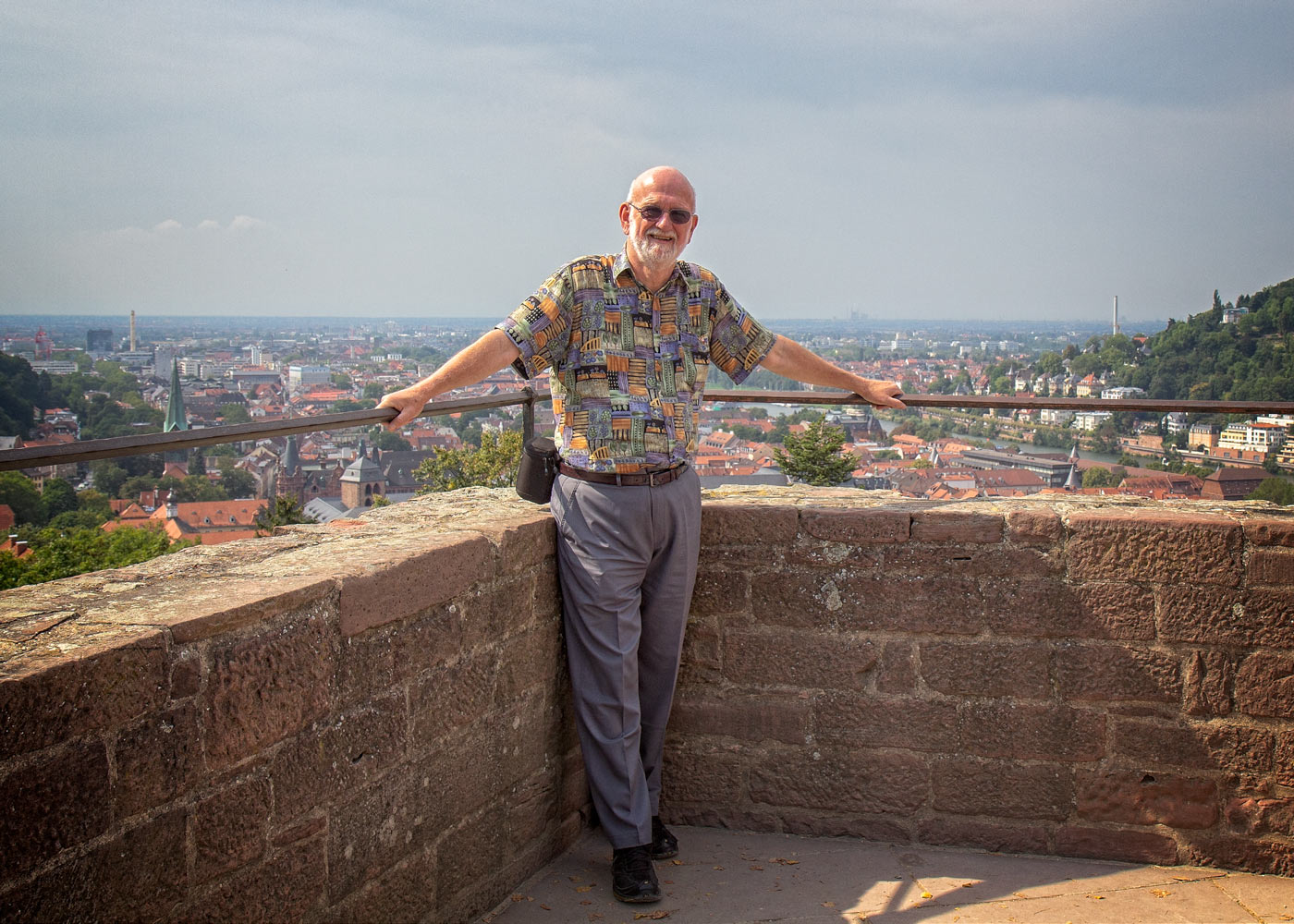
This is the second time I have stood in this spot. The first was in 1960 while I was cycling in Europe.
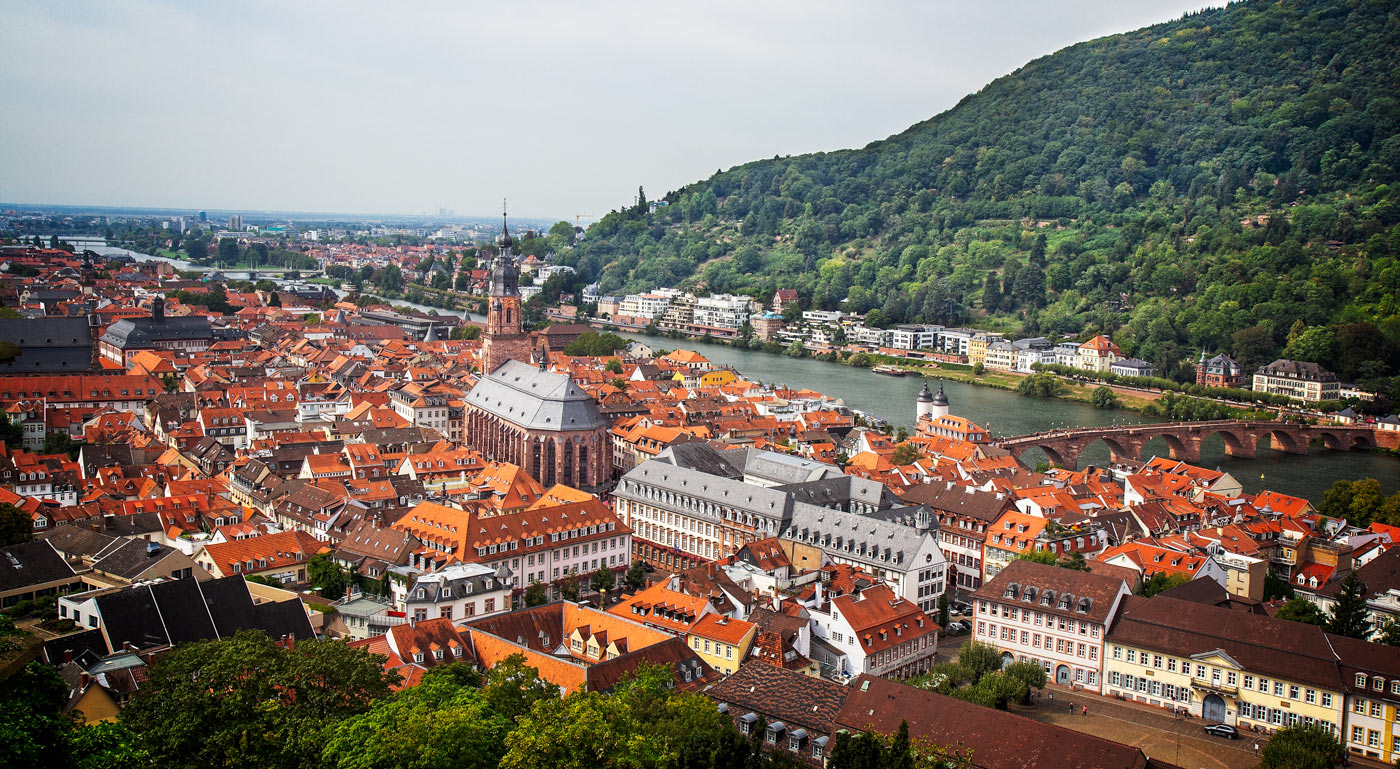
This is the view of Heidelberg from the castle patio. The church is the protestant Church of the Holy Spirit built between 1398 and 1515. The bridge on the right is the Karl Theodor Bridge finished in 1788. Today it is restricted to mostly pedestrian traffic. There have been bridges here since Roman times.
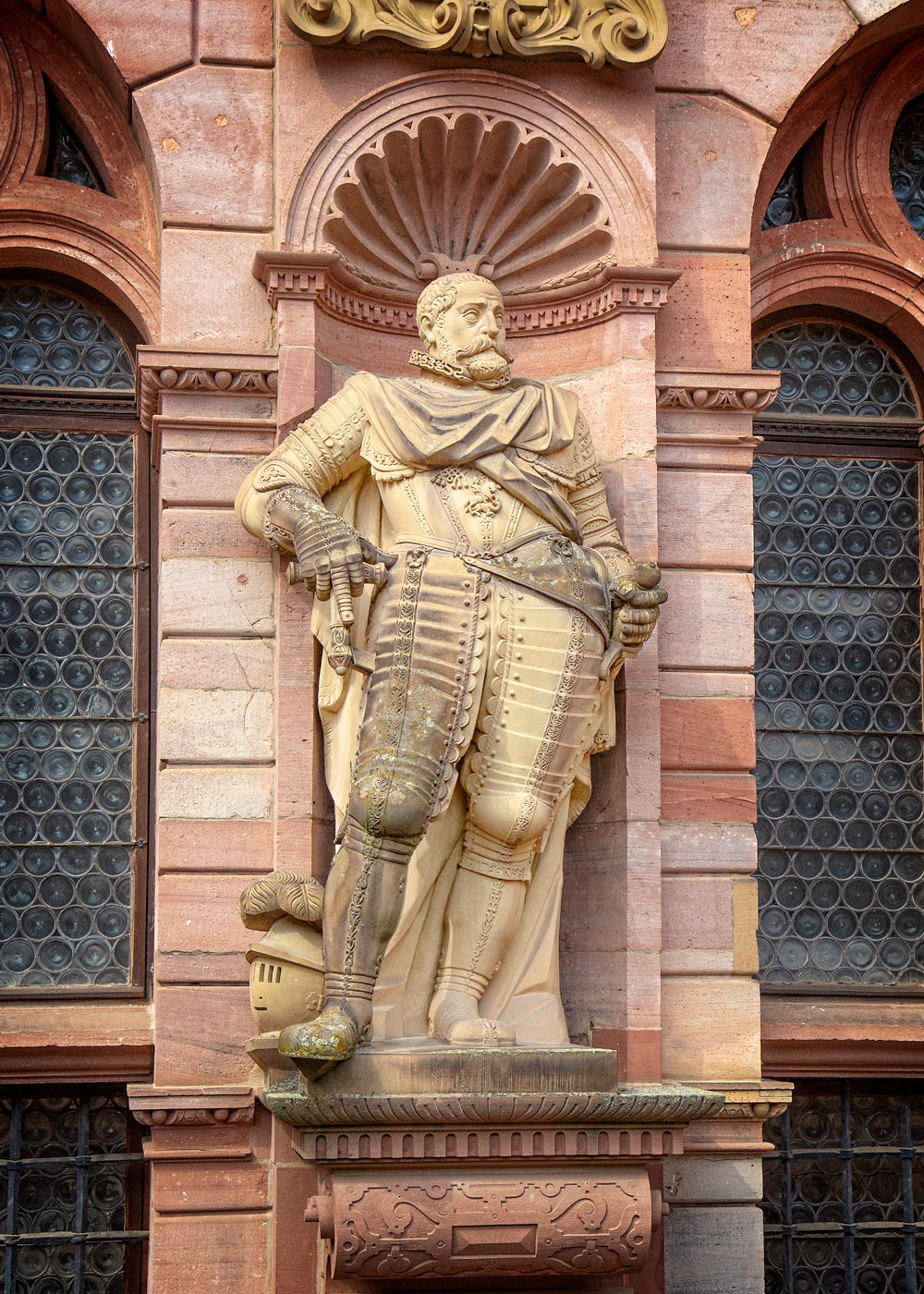
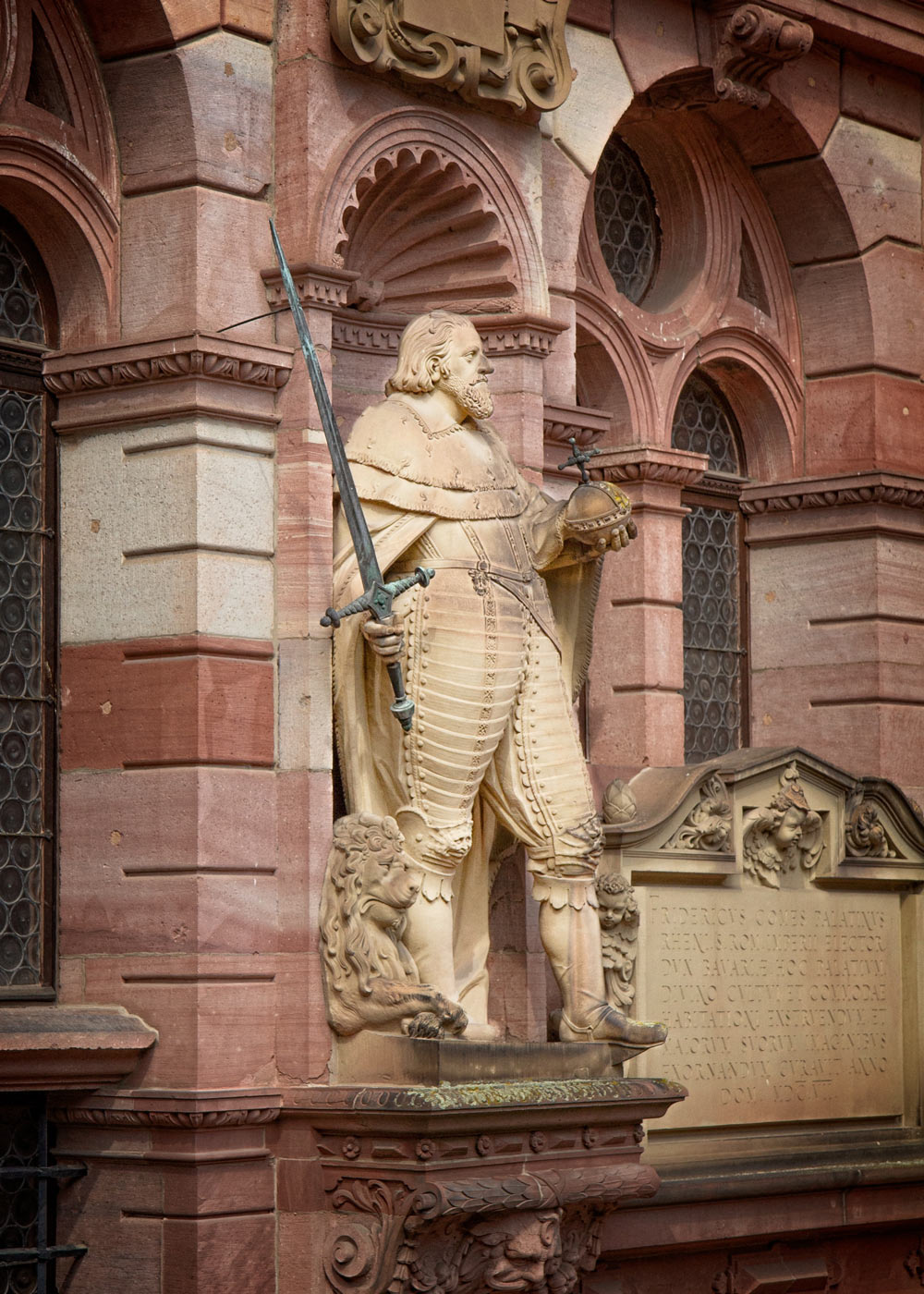
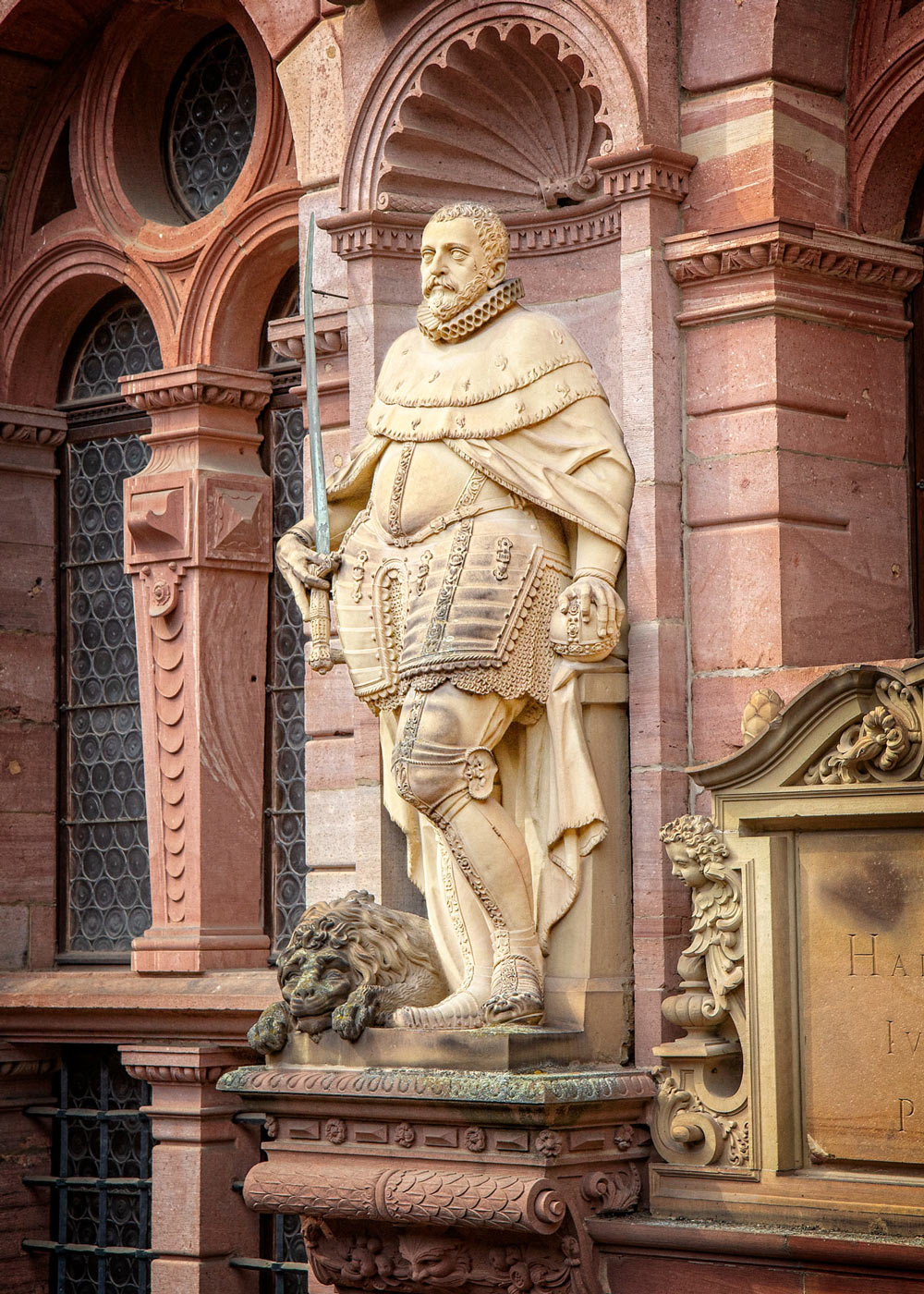
The parts of the castle that have been restored give you an idea of how magnificant it must have been at one time.
In the basement of the Schloss Heidelberg is a really interesting artifact that escaped the destruction of the rest of the castle. Over the years the rulers who lived in the castle collected taxes and much of the payments were in the form of wine, money not being as common a currency as it is now. Over the centuries four great wine casks were built to house this treasure, two of which remain to this day.
The first was built in 1591 but it was destroyed during the Thirty Years War (1615-1648). The second was built in 1664 and exists to this day. It holds about 200,000 liters and is so large it has a dance floor on top.
The thrid was built in 1728 but no longer exists and the last was built in 1751 and still survives. They are so old now that they no longer can hold wine and they have for years been simply a tourist curiosity. To see them you now have to buy a ticket and walk into the castle cellar where they have been all these centuries. But they are something to see! So many oak trees just to hold wine. They must have been real drinkers in the old days.
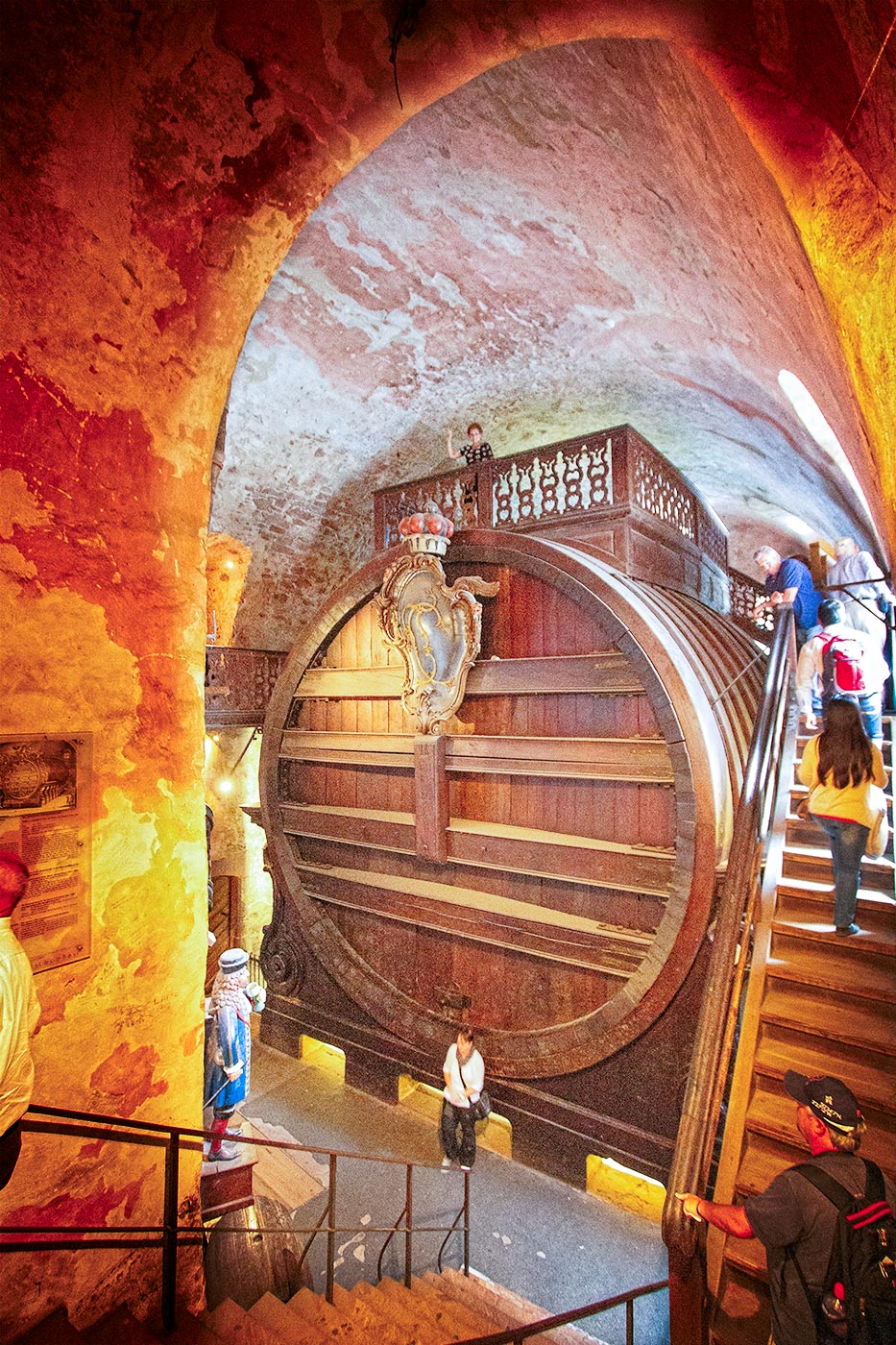
This is the Barrel of 1664 with a dance floor on top. At the top against the railing you can see Susan.
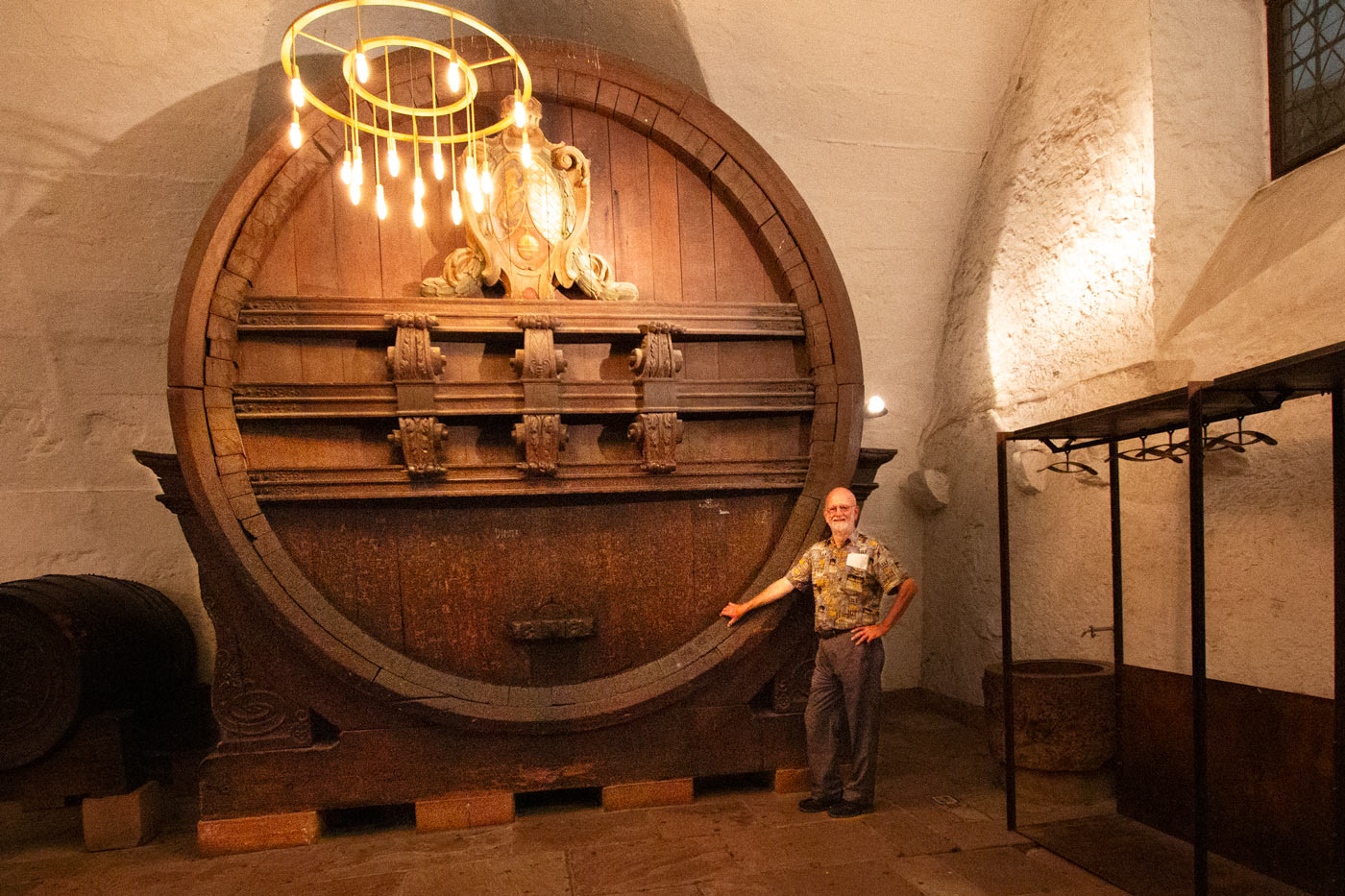
I am standing in front of the barrel from 1751 which is smaller than the one in the picture on the left. Even so, it is very impressive. But I wonder how good the wine would be after a year or two in one of these.
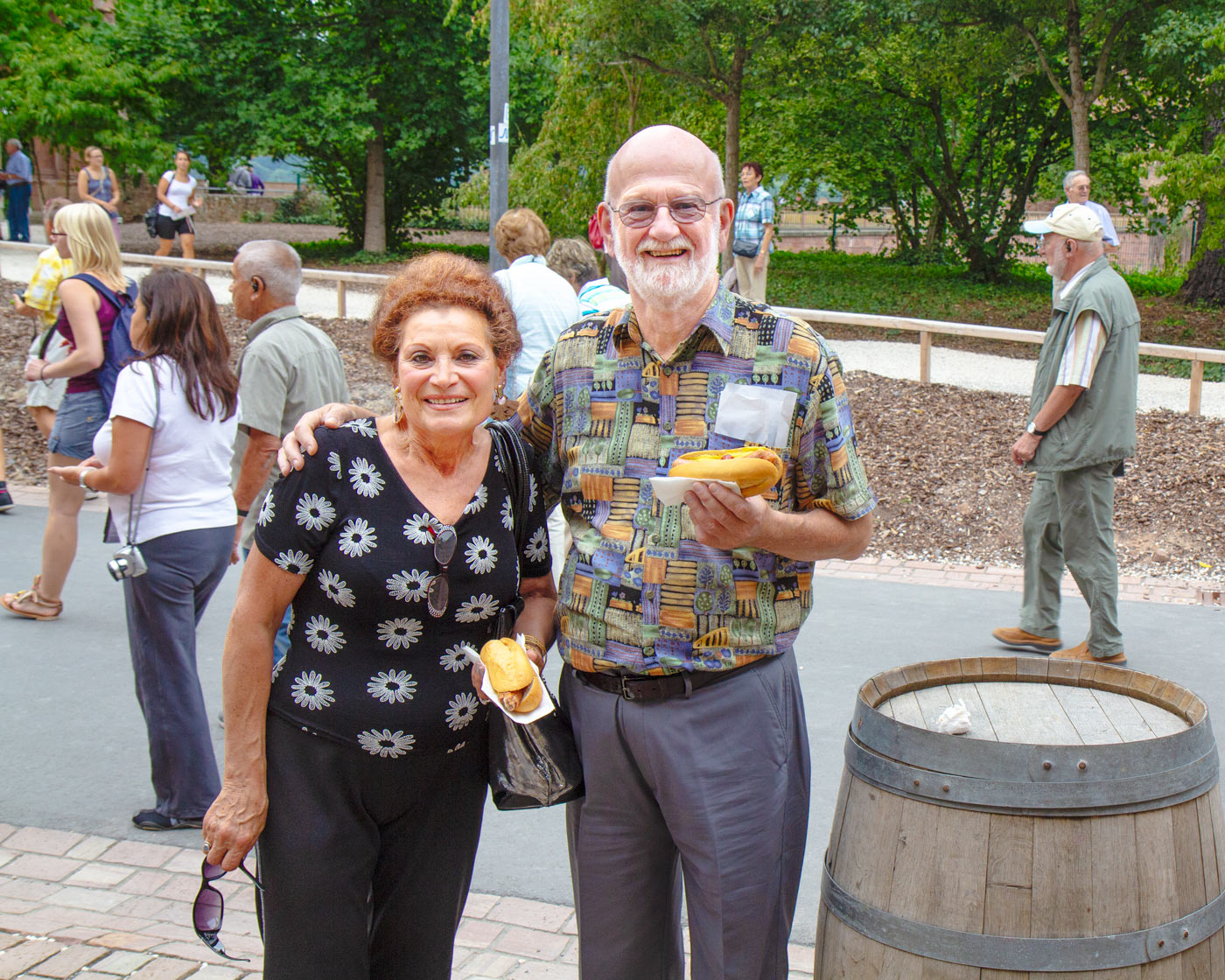
Before we left the Schloss Heidelberg we had a hot dog and coffee. A fellow tourist took this picture for us.
But we were always watching our clock. We had to leave before we had a chance to walk in old Heidelberg or along the banks of the Neckar. We grabed a hot dog and coffee before we left and then we were off.
Because we wanted to be in Switzerland by nightfall, and we still had a long ways to go, we took the autobahn and made for Basel. Even on the freeway we did not get to the border until early evening. Because Switzerland is not in the European Union and because you have to pay a road tax and get a tax sticker for your windshield we had to stop at the border for a few minutes.
We did not stop in Basel but drove past by a few kilometers and then looked for a hotel. In the little community of Sissach we found the Hotel Sur Sonne where we stopped. A nice hotel with an excellent dinning room. We had dinner and walked around the neighbourhood a bit before bed.
We were in Switzerland looking forward to tomorrow.
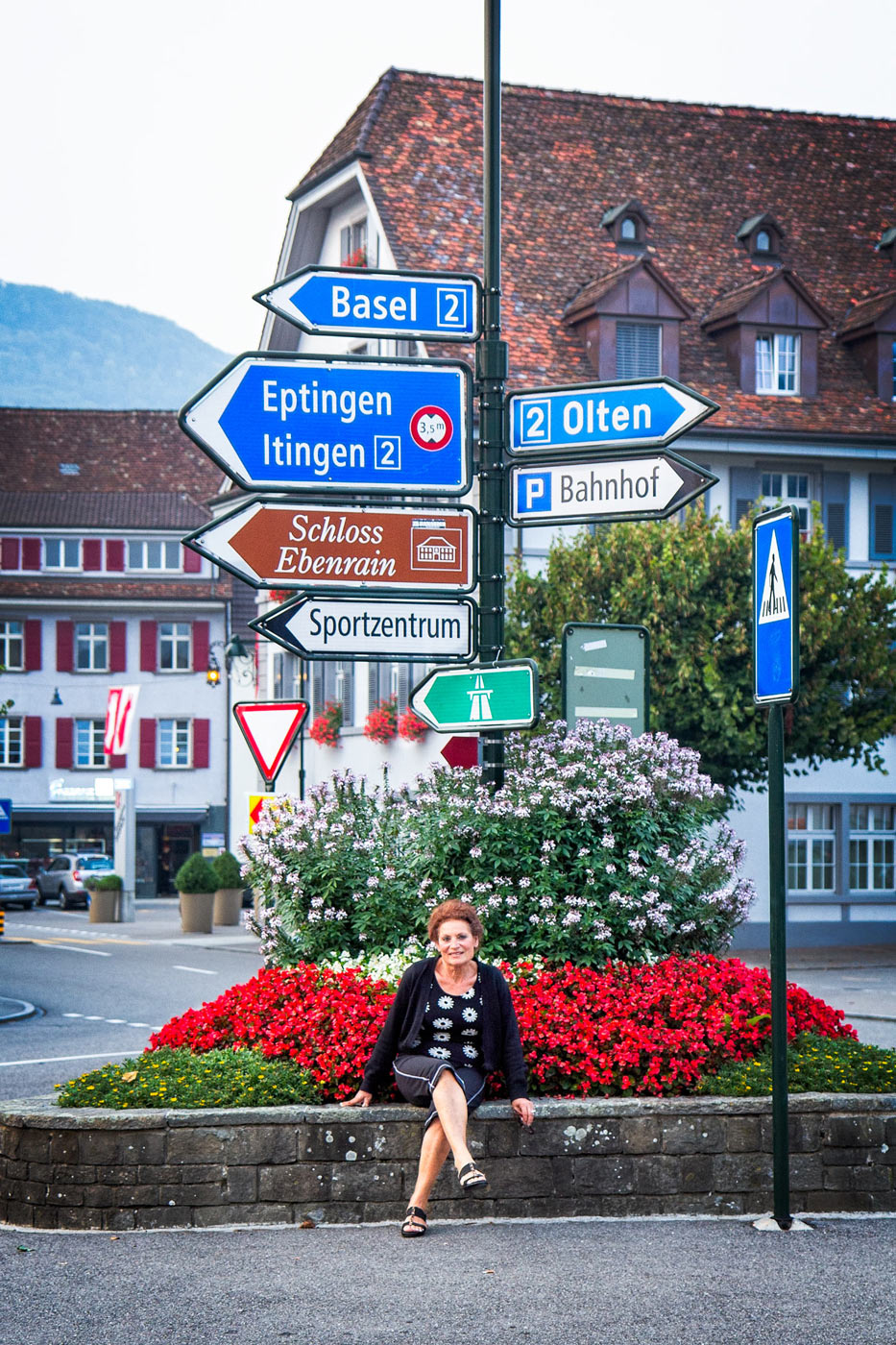
Susan sitting at an intersection in the town of Sissach, Switzerland, which you can see is 2 kilometers from Basel.
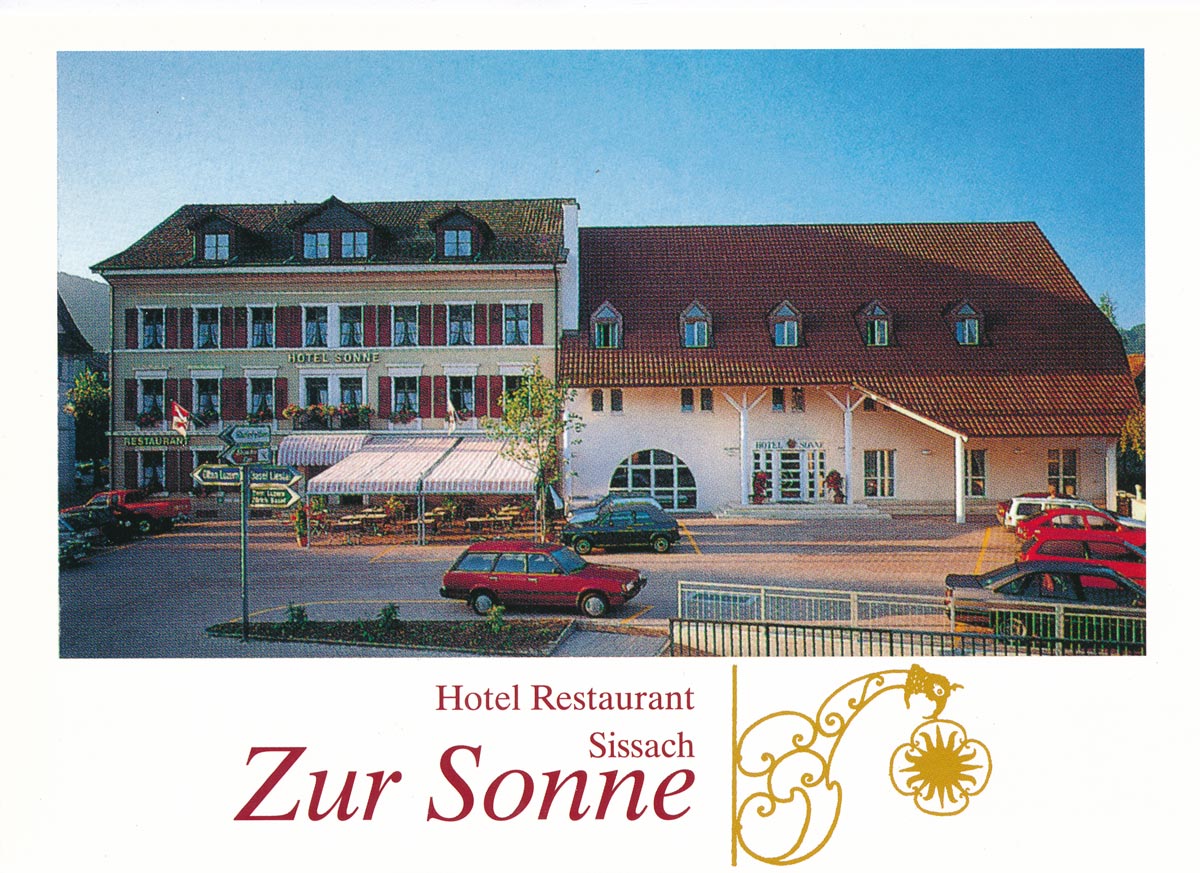
A post card from our hotel in Sissach, the Hotel Sonne.
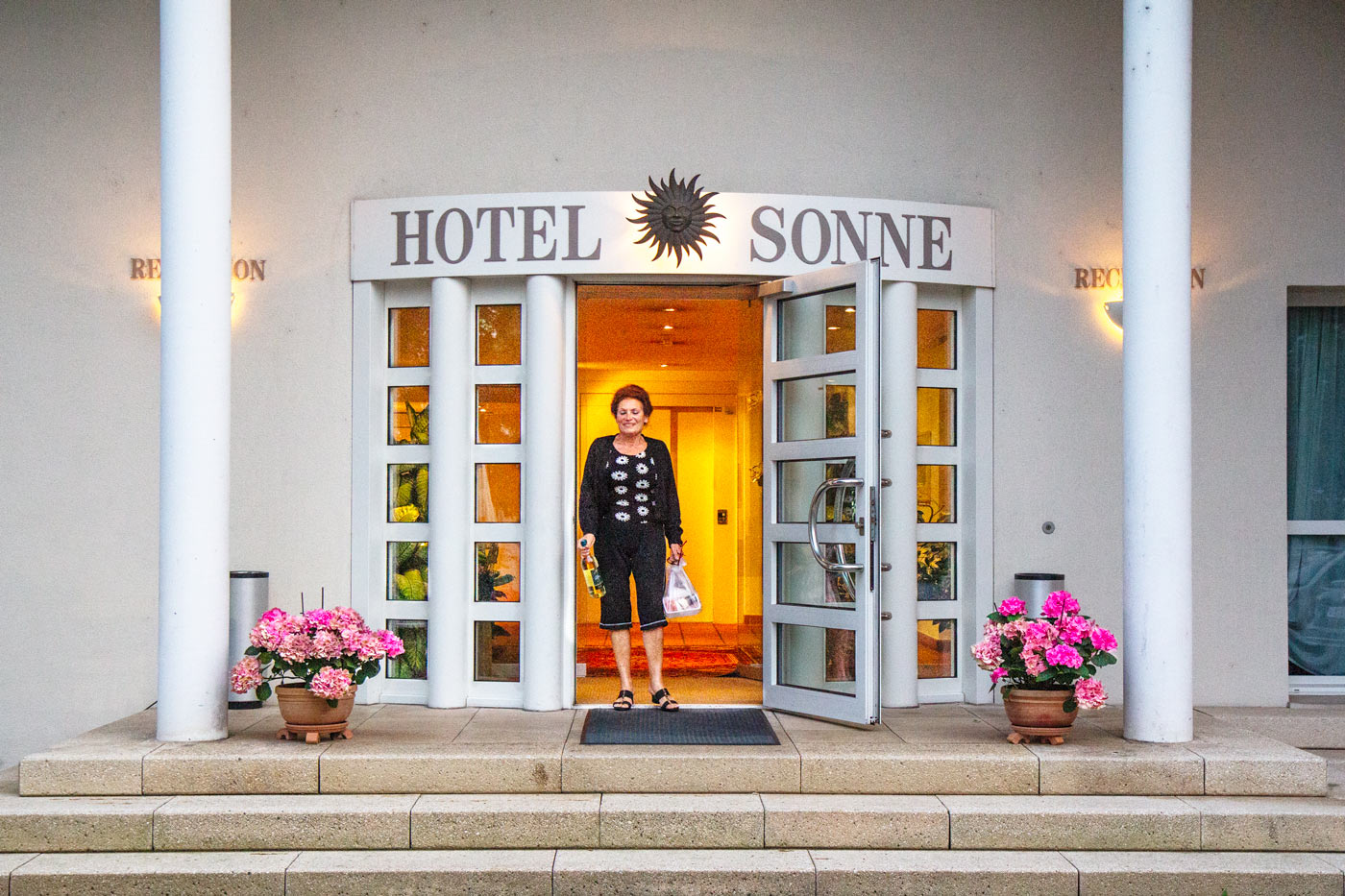
Susan here is standing in the front door to the Hotel Sonne. This was a great little hotel and the people there could not have been nicer!
This website is the work of R. Flynn Marr who is solely responsible for its contents which are subject to his claim of copyright. User Manuals, Brochures and Advertising Materials of Canon and other manufacturers available on this site are subject to the copyright claims and are the property of Canon and other manufacturers and they are offered here for personal use only. Use of this website is governed by the Terms of Service set out on the page by that name.

The True North Strong and Free